Ready to plan smarter? This concise guide gives you a future-ready view of the IBPS Clerk Syllabus and Exam Pattern 2026 so you can organise study time with confidence.
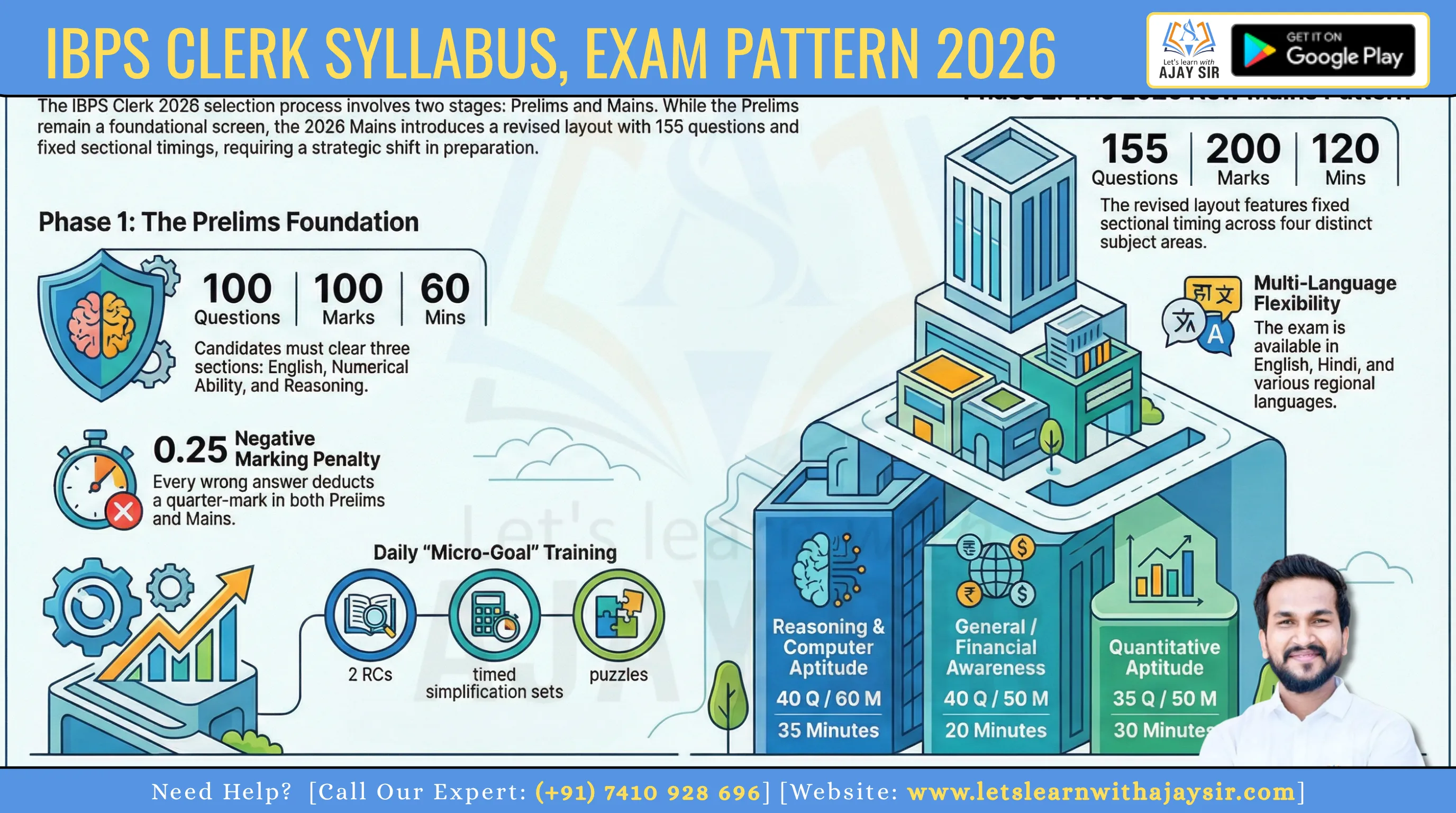
The selection has two stages: Prelims and Mains. Prelims test English, Numerical Ability and Reasoning. Mains covers General/Financial Awareness, Reasoning & Computer Aptitude, Quantitative Aptitude and English. Note the negative marking of 0.25 for each wrong answer in both stages.
The revised Mains format has 155 questions, 200 marks, 120 minutes with sectional timing. Section weights are clear: Reasoning & Computer Aptitude (40Q/60M/35m), English (40Q/40M/35m), Quantitative Aptitude (35Q/50M/30m) and General/Financial Awareness (40Q/50M/20m). The test is offered in English, Hindi and regional languages, helping candidates pick the language that suits them best.
Read on to learn what changed, which topics carry high yield and how to adapt practice without relearning the whole clerk syllabus 2026 to 2026 shift.
Quick Overview
IBPS Clerk Syllabus and Exam Pattern 2026: What’s new for 2026
A fresh mains layout now changes how time, marks and section weightage play out. The mains has been revised to 155 questions for 200 marks in 120 minutes, with fixed sectional timing. This shift changes how you allocate effort during the paper.
Key changes at a glance
Sections now run as: Reasoning & Computer Aptitude 40Q/60M (35 minutes), English 40Q/40M (35 minutes), Quantitative Aptitude 35Q/50M (30 minutes) and General/Financial Awareness 40Q/50M (20 minutes). Note the new question counts and marks per section.
What hasn’t changed
The core subjects and most topic lists remain intact, so your existing notes and topic-wise preparation still apply. Focus on speed, accuracy and section sequencing rather than relearning material.
Who is impacted and how to adjust
Repeat candidates should refine pacing to fit the 35-35-30-20 minute blocks.
First-time candidates can adopt the new routine early in mocks.
Rebalance practice towards Reasoning & Computer Aptitude and GA, as they now carry heavier marks.
Syllabus & Exam Pattern
IBPS Clerk Syllabus and Exam Pattern 2026
Preparation must cover a quick prelim filter and a deeper mains assessment. You face two phases: Prelims screens core skills while Mains tests workplace readiness with four focused sections.
Prelims has 100 questions for 100 marks in 60 minutes. The section split is English 30Q/30M/20m, Numerical Ability 35Q/35M/20m and Reasoning Ability 35Q/35M/20m. Practise at a steady speed to cross cut‑offs comfortably.
Mains now totals 155 questions for 200 marks in 120 minutes with fixed sectional timing. The four areas are General/Financial Awareness, Reasoning & Computer Aptitude, Quantitative Aptitude and English Language. Focus on accuracy—wrong answers carry a 0.25 mark penalty in both stages.
Phase | Questions | Marks | Duration |
Prelims | 100 | 100 | 60 mins |
Mains | 155 | 200 | 120 mins |
Train in your chosen language early; tests run in English, Hindi and regional languages.
Use sectional drills and full tests to set per‑section speed targets.
Plan to protect score by avoiding guesses when uncertain because of the negative mark.
IBPS Clerk Syllabus 2026: Prelims [English, Numerical Ability, Reasoning Ability]
The prelims split into three key sections that reward steady practice. You get a clear topic list for each section so your daily study slots map to the blueprint. Use short, timed drills to build confidence fast.
English Language essentials
Focus on reading comprehension, cloze tests and para jumbles for comprehension speed. Add grammar drills: error spotting, sentence improvement, active/passive and direct/indirect speech.
Work on vocabulary through synonyms/antonyms and spellings. Two RCs and two cloze tests daily will lift both speed and accuracy.
Numerical Ability priorities
Start with simplification and approximation, number series and quadratic practice to sharpen calculation sense. Move to DI (tables, bar, line, pie) and core arithmetic topics like percentages, ratio, averages and time & work.
Include weekly probability, permutation & combination and mensuration sets to cover all question types.
Reasoning Ability focus
Daily puzzle and seating arrangement practice builds pattern recognition. Layer coding‑decoding, syllogism, inequalities and alphanumeric series for breadth.
Keep blood relations, direction sense and order & ranking in rotation; they are quick wins once logic patterns are internalised.
Study checklist
Map topics to daily micro‑goals: timed RCs, cloze, arithmetic sets and puzzles.
Practise DI formats and mixed data interpretation regularly.
Use sectional mocks to refine attempt order and leaving strategy within the 20‑minute block per section.
Section | Core topics | Daily target |
English Language | RC, cloze, grammar, vocab, para jumbles | 2 RCs, 2 cloze, 15 min grammar |
Numerical Ability | Simplification, series, DI, arithmetic, quadratic | Timed simplification set + 1 DI |
Reasoning Ability | Puzzles, seating, coding, syllogism, blood relations | 1 puzzle set + 20 min reasoning mix |
IBPS Clerk Syllabus 2026: Mains Syllabus
Each mains section demands a distinct mix of knowledge, practice and time control. You will divide study time to cover General/Financial Awareness, Reasoning Ability & Computer Aptitude, Quantitative Aptitude and English Language. This approach keeps revision focused and measurable.
General/Financial Awareness
Make current affairs a daily habit. Cover the last six months of national and international headlines, RBI circulars, major schemes and key banking terms.
Quick wins: appointments, currencies, regulator updates and scheme names for rapid recall.
Reasoning Ability & Computer Aptitude
Advance puzzle practice: multi‑variable seating, distribution, inequalities and input‑output. Use data sufficiency items to sharpen decision skills.
Computer basics to revise weekly: MS Office (especially Excel), OS concepts, networking, databases, security tools and common cyber threats.
Quantitative Aptitude
Prioritise DI variations—tabular, caselet and mixed charts—while keeping arithmetic, algebra and probability sharp.
Use mixed sets and timed DI drills to replicate mains difficulty and boost speed.
English Language
Work denser RCs, precise vocabulary, error‑spotting and editing tasks. Practise para jumbles, idioms and advanced grammar for higher accuracy.
Section | High‑yield topics | Daily practice focus |
General/Financial Awareness | Current affairs, RBI/SEBI updates, schemes | 10‑15 mins news + GK notebook |
Reasoning & Computer Aptitude | Puzzles, seating, Excel, networking | 30 mins puzzles + 15 mins computer |
Quantitative Aptitude | DI, arithmetic, algebra, probability | 30 mins DI + 20 mins arithmetic |
English Language | RC, vocab, error spotting, para jumbles | 25 mins RC + vocab drills |
IBPS Clerk exam pattern 2026: latest prelims and mains structure
Knowing exact counts, marks and minutes helps you plan what to attempt first and what to skip.
Prelims pattern: the prelims exam has 100 questions for 100 marks in 60 minutes. The split is English 30Q/30M, Reasoning 35Q/35M and Numerical 35Q/35M. Choose your language (English or Hindi) for all sections except the English paper and set targets per 20-minute block.
Mains (latest): the mains now carries 155 questions for 200 marks in 120 minutes with fixed sectional timing. Reasoning & Computer Aptitude: 40Q/60M/35 minutes; English: 40Q/40M/35 minutes; Quantitative Aptitude: 35Q/50M/30 minutes; General/Financial Awareness: 40Q/50M/20 minutes. Note the higher weightage for Reasoning & Computer Aptitude (60 marks).
Align mocks to the official number of questions and minutes to build stamina.
Practice pacing for 35/35/30/20 minute blocks and plan skipping rules by section.
Confirm your language medium (English/Hindi/regional) and keep practice in that medium.
Phase | Questions | Marks |
Prelims | 100 | 100 |
Mains | 155 | 200 |
Marking scheme, time management and tie-breaking policy
Knowing how marks are cut and time is split makes a real difference on test day. You should learn the penalty rules and pacing so each decision adds to your score, not subtracts from it.
Negative marking in prelims and mains: penalty for wrong answers
A wrong answer costs 0.25 marks in both Prelims and Mains. That single rule should guide every attempt: if your chance of an answer being correct is low, skip it. Calibrate guesses during practice so you avoid losing marks on risky attempts.
Finally, train your bubbling and submission habits in mock tests so every answer you lock in is deliberate. This small discipline saves precious marks on the actual day.
All Details
Conclusion
With the new mains layout and steady syllabus, you can shape study time that truly moves the needle. The revised mains (155 questions for 200 marks with fixed sectional timing) and the 0.25 negative mark make timing and accuracy your top priorities.
Plan a weekly routine that blends concept work, sectional practice and full mocks in your chosen language. Use mock analytics to cut weak patterns, set realistic attempt targets per section and protect marks by avoiding low‑confidence answers.
Follow this plan and you will approach selection with calm focus. Start your first week today and let steady practice turn preparation into performance on test day.
Disclaimer:
All eligible and interested candidates are advised to read the official notification carefully before applying online.
Disclaimer: The examination results and marks published on this website are provided solely for immediate information to candidates and do not constitute a legal document. While every effort has been made to ensure the accuracy and authenticity of the information available on this website, we are not responsible for any inadvertent errors that may occur in the publication of examination results or marks. We shall not be liable for any loss or damage to any individual or entity arising from any deficiency, defect, or inaccuracy in the information provided on this website.

![EMRS PGT [Tier-2] ENGLISH - 2025](https://letslearnwithajaysir.s3.ap-south-1.amazonaws.com/courses/FsnKxIFpiLxbRD418g6vo7AsLy0ge7IP7Iu2fsJY.webp)
![EMRS TGT [Tier-2] ENGLISH - 2025](https://letslearnwithajaysir.s3.ap-south-1.amazonaws.com/courses/BjLXVqVV1SeZKnhYjmPZpz2jQ7r02kS73pGGOLrL.webp)
![KVS/NVS PGT ENGLISH [Tier-2] - 2025](https://letslearnwithajaysir.s3.ap-south-1.amazonaws.com/courses/vqli598KWrKnm4txcsZh5qjMN9UMAX8LvFk9IiF0.webp)
![KVS/NVS TGT ENGLISH [Tier-2] - 2025](https://letslearnwithajaysir.s3.ap-south-1.amazonaws.com/courses/pxC2WhfYKuyaoGqvcTvhTBL2Y44o3TNA0z8NYRB5.webp)