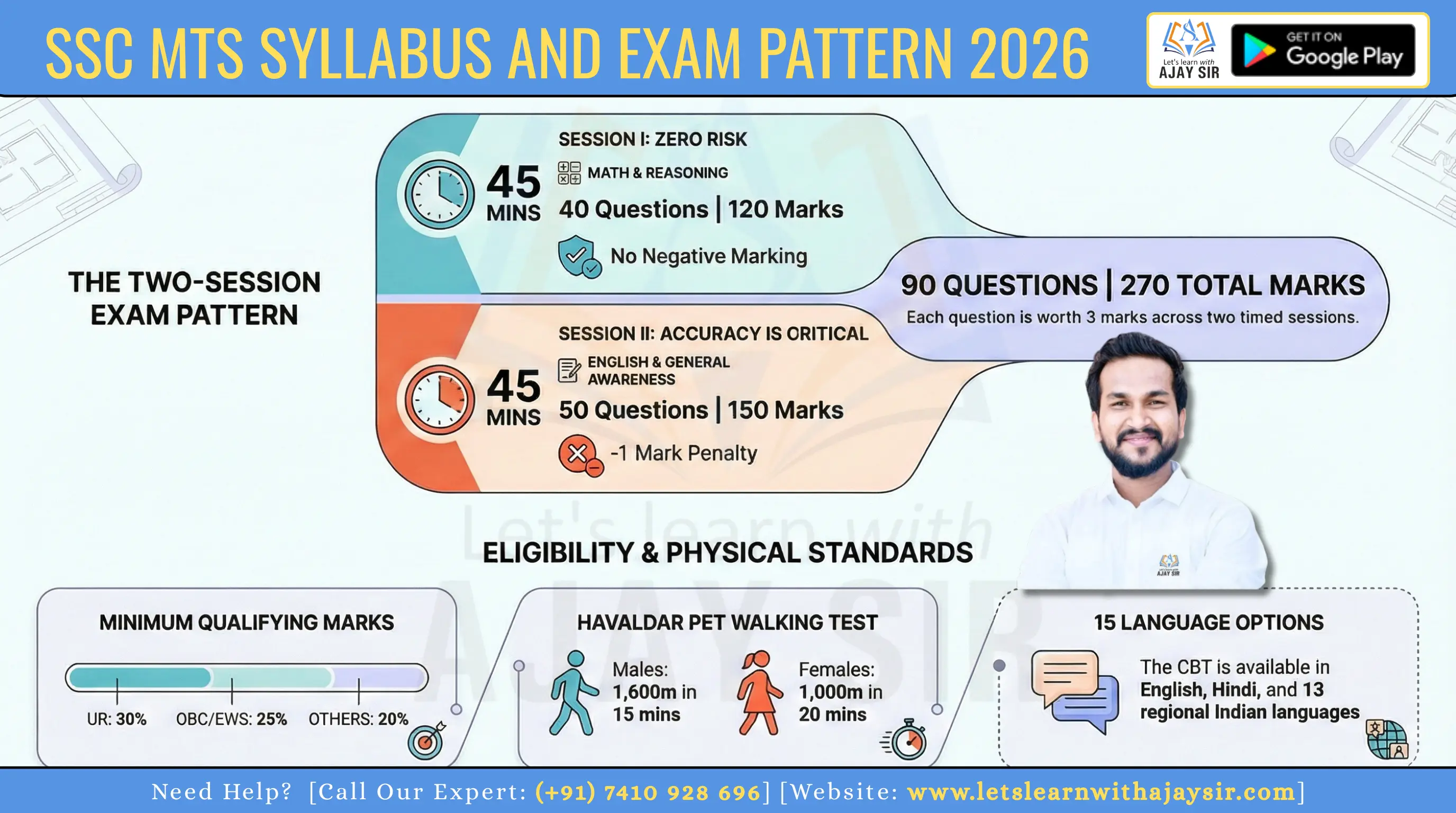
This guide gives you a clear blueprint of Paper‑I under the revised structure. You will see how the two‑session CBT is split, the total of 90 questions for 270 marks, and why attempting both sessions is compulsory to avoid disqualification.
Session I covers Numerical & Mathematical Ability and Reasoning Ability & Problem Solving. Each part has 20 questions worth 60 marks and you get 45 minutes. Session II carries General Awareness and English Language & Comprehension with 25 questions per part, 75 marks each and 45 minutes.
Note the marking rules: Session I has no penalty, while Session II deducts one mark for a wrong answer. The CBT is offered in 15 Indian languages, so pick the medium that maximises your speed and accuracy.
You will also find the minimum qualifying marks by category, Havaldar PET/PST standards, and trusted book recommendations to help you plan study time and practice effectively before the official notification appears on the staff selection commission website.
Syllabus & Exam Pattern
Revised exam pattern 2026: Paper-I
Get a clear view of how sessions, timing and marks combine so you can prepare smartly. The paper is split into two timed sessions. Each session lasts 45 minutes and demands focused pacing.
Session I: Numerical & Mathematical Ability; Reasoning Ability & Problem Solving
Contents: 40 questions — 20 on numerical topics and 20 on reasoning. Each question carries 3 marks, so this session is worth 120 marks.
Key point: there is no penalty here, so attempt questions you can solve quickly and bank secure marks.
Session II: General Awareness; English Language & Comprehension
Contents: 50 questions — 25 on general awareness and 25 on comprehension and grammar, totalling 150 marks.
Negative marking: Session II applies a 1‑mark deduction for wrong answers, so limit blind guessing and favour accuracy.
Number of questions, marks distribution and section‑wise weightage
The full paper has 90 questions for 270 marks. Each question = 3 marks. Plan target attempts per section based on this distribution to hit your target score reliably.
Languages available for the computer‑based test
You may choose from 15 languages including English, Hindi, Bengali, Marathi, Tamil, Telugu and Urdu. Pick the language that gives you fastest comprehension and least error on test day.
Disqualification triggers and best practices on exam day
Missing either session leads to disqualification — arrive early and follow time rules.
Carry required ID and admit details to avoid admin rejection.
Use a minute‑per‑question plan with a 10–15% review buffer per session.
Item | Detail | Action |
Total questions | 90 | Set section targets before the test |
Marks per question | 3 | Prioritise accuracy in Session II |
Penalty | -1 in Session II | Avoid random guesses |
SSC MTS Syllabus 2026
Map out the four core subjects so you can build a weekly routine that balances practice and revision. This section breaks the full ssc mts syllabus into clear, doable topic sets tied to each session of the exam.
Numerical and Mathematical Ability: core arithmetic and applied maths
Focus: number system, HCF/LCM, percentage, ratio & proportion, averages, time & work, speed & distance, profit & loss, simple and compound interest, DI, algebra, geometry, mensuration and basic trigonometry.
Reasoning Ability and Problem Solving: verbal and non‑verbal coverage
Cover series, coding‑decoding, analogy, odd one out, syllogism, blood relations, direction sense, ranking and matrix. Add non‑verbal practice: paper folding, mirror image, embedded figures and counting shapes to sharpen pattern recognition.
English Language and Comprehension
Drill error spotting, fill‑in, sentence improvement, synonyms and antonyms, spelling, idioms, one‑word substitution and passage comprehension. Build vocabulary and grammar checkpoints to boost speed on questions.
General Awareness
Revise Indian polity, economy, history, culture, basic science, awards and current affairs at a Class‑10 level. A short daily news habit plus weekly static revision keeps awareness steady without overload.
Rotate these subjects weekly to balance aptitude, reasoning, english language and awareness practice.
Prioritise high‑yield topics like percentages, ratio, series and synonyms to raise your score quickly.
SSC MTS Syllabus 2026: Numerical and Mathematical Ability
Mastering calculations will save you time and boost confidence on exam day. Start by building reliable mental maths habits and a five-minute daily drill of tables, squares and fractions. This routine reduces sloppy errors and speeds up your paper execution.
Number system, LCM/HCF, decimals and fractions
Common question types: quick comparisons, LCM/HCF tricks, conversion between decimals and fractions, and simplification under time pressure. Practise mental reduction and shortcut division to cut working time.
Percentages, ratio and proportion, averages and mixtures
You will face multi-step word problems that mimic previous year trends. Use percentage-to-fraction swaps, ratio scaling and average‑based shortcuts to handle these efficiently.
Time, speed and distance; time and work
Expect ratio methods, uniform speed calculations and LCM-based time allocation for work problems. Learn easy formulas and practise shortcut strategies to protect minutes.
Profit, loss, discount, simple and compound interest
Memorise formula families and comparative setups for trap-laden language problems. Comparative SI/CI questions appear often; convert words into equations fast.
Geometry, mensuration, algebra, trigonometry and DI basics
Keep a compact formula sheet for circles, triangles and common solids. Link simple algebra and trig to data interpretation so you can read charts and solve DI items quickly.
Plan a minute-per-question cadence for Session I; accuracy matters since there is no negative marking.
Use previous year analysis to prioritise high‑recurrence subtopics and allocate extra practice sets.
Track your accuracy versus speed weekly and adjust practice focus accordingly.
Topic | Typical question | Practice focus |
Percentages | Multi-step word problems | Conversion & shortcut methods |
Time & Work | Combined work and efficiency | LCM and ratio drills |
DI & Algebra | Chart reading with equations | Link algebra to visual data |
SSC MTS Syllabus 2026: Reasoning Ability and Problem Solving
This section breaks down the reasoning families so you can target high‑yield items first. Session I allocates 20 reasoning questions worth 60 marks and carries no negative marking. Use that to attempt confidently while keeping speed steady.
Classify reasoning into verbal and non‑verbal blocks. Tackle series, coding‑decoding, analogy and odd‑one‑out early to capture quick marks. Practise alphanumeric patterns and common transformations until spotting rules becomes instinctive.
Logical templates and short methods
Use Venn logic for syllogisms and template notes for ranking, direction sense and blood relations. Compact notations save time and prevent messy work under pressure.
Matrix, dictionary order and visual puzzles
Apply row/column logic for matrices and lexicographic rules for dictionary sequencing. For mirror image, paper folding, embedded figures and counting shapes, build a visual checklist: symmetry, fold lines, overlaps and hidden segments.
Convert practice into timed micro‑sets to mirror exam rhythm.
Exploit the absence of negative marking by increasing safe attempts after accuracy improves.
Track errors in a spaced‑repetition log so tricky subtypes are revisited until reliable.
Item | Focus | Practice tip |
Series & Coding | Pattern spotting | Daily 10‑item drills |
Syllogism & Ranking | Logical templates | Venn shortcuts |
Non‑verbal | Mirror/folding | Sketch checks & timing |
SSC MTS Syllabus 2026: English and General Awareness
This section shows how to turn English practice and factual revision into reliable marks. Session II has 25 English questions and 25 general awareness items with negative marking, so accuracy matters more than raw attempts.
English Language and Comprehension
Focus on error spotting, sentence improvement, fill‑in, one‑word substitution and short RCs. Train scanning and trigger‑word techniques to find answers fast in passages.
Adopt a daily 20‑minute cycle: 10 minutes of vocabulary and idioms, 10 minutes of grammar or a short comprehension. Revise spelling patterns and commonly confused words to avoid simple losses.
General Awareness essentials and current affairs
Cover the constitution, polity, economy, history, culture and basic science at Class‑10 depth. Build a weekly rotation and a concise summary for last‑week revision.
Map previous year questions to spot high‑frequency themes.
Keep a short current affairs list tied to the notification‑to‑exam window (schemes, appointments, awards).
Skip uncertain GA items early and return if time permits—protect your net score under the -1 rule.
Area | Quick tip | Practice |
Comprehension | Scan for verbs and names | Timed 5‑minute passages |
Vocabulary | Learn usage, not just meanings | Flashcards, context sentences |
General awareness | Focus on repeat topics | Weekly static + daily current affairs |
SSC MTS Syllabus 2026: Qualifying marks, languages
Knowing the pass marks and fitness norms up front helps you plan mocks and physical training. Match your average test scores to category cut‑offs so you set realistic targets and avoid surprises on result day.
Minimum qualifying criteria by category
UR: 30% | OBC / EWS: 25% | All other categories: 20%.
Use these percentages as baseline marks when you assess mock performance. Aim higher in Session II because negative marking affects net score.
Approved CBT languages across India
Choose your exam language early and practise all mocks in that medium to avoid context switching. The full list includes:
English, Hindi, Assamese, Bengali, Gujarati
Kannada, Konkani, Malayalam, Manipuri, Marathi
Odia, Punjabi, Tamil, Telugu, Urdu
Havaldar PET and PST requirements
Male (PST): height 157.5 cm; chest 76 cm unexpanded with 5 cm expansion (81 cm). Height relaxable by 5 cm for Garhwalis, Assamese, Gorkhas and ST.
Female (PST): height 152 cm; weight 48 kg. Height relaxable by 2.5 cm and weight relaxable by 2 kg for specified categories.
PET walking: Male: 1,600 m in 15 minutes. Female: 1,000 m in 20 minutes. Build a simple fitness plan if you aim for a Havaldar post.
Area | Requirement | Relaxation (where applicable) | Action for candidates |
Qualifying marks | UR 30%; OBC/EWS 25%; Others 20% | Not applicable | Set mock targets above these percentages |
CBT languages | 15 approved languages (listed) | Choose strongest medium | Complete all practice in chosen language |
Male PST & PET | Height 157.5 cm; Chest 76/81 cm; Walk 1,600 m/15 min | Height relaxable by 5 cm for select regions | Measure stats and start walking drills |
Female PST & PET | Height 152 cm; Weight 48 kg; Walk 1,000 m/20 min | Height relaxable by 2.5 cm; Weight relaxable by 2 kg | Plan fitness and obtain medical checks |
All Details
Conclusion
Finish your preparation with a clear plan that links daily drills to full‑paper mocks. Treat the two‑session format—90 questions for 270 marks—as the backbone of your routine. Focus on timing in Session I and accuracy in Session II because negative marking applies there.
Keep resources lean: one main book per subject, solved papers and regular mocks. Practise in your chosen test language to reduce errors and refine question selection under pressure.
Balance work on numerical, reasoning, English and general awareness. Set weekly targets, track progress honestly and prepare for Havaldar PET/PST if you aim for that selection path.
Finally, watch the official portal for updates. With steady effort and a targeted plan you will approach the ssc mts exam with confidence and clarity.

![EMRS PGT [Tier-2] ENGLISH - 2025](https://letslearnwithajaysir.s3.ap-south-1.amazonaws.com/courses/FsnKxIFpiLxbRD418g6vo7AsLy0ge7IP7Iu2fsJY.webp)
![EMRS TGT [Tier-2] ENGLISH - 2025](https://letslearnwithajaysir.s3.ap-south-1.amazonaws.com/courses/BjLXVqVV1SeZKnhYjmPZpz2jQ7r02kS73pGGOLrL.webp)
![KVS/NVS PGT ENGLISH [Tier-2] - 2025](https://letslearnwithajaysir.s3.ap-south-1.amazonaws.com/courses/vqli598KWrKnm4txcsZh5qjMN9UMAX8LvFk9IiF0.webp)
![KVS/NVS TGT ENGLISH [Tier-2] - 2025](https://letslearnwithajaysir.s3.ap-south-1.amazonaws.com/courses/pxC2WhfYKuyaoGqvcTvhTBL2Y44o3TNA0z8NYRB5.webp)