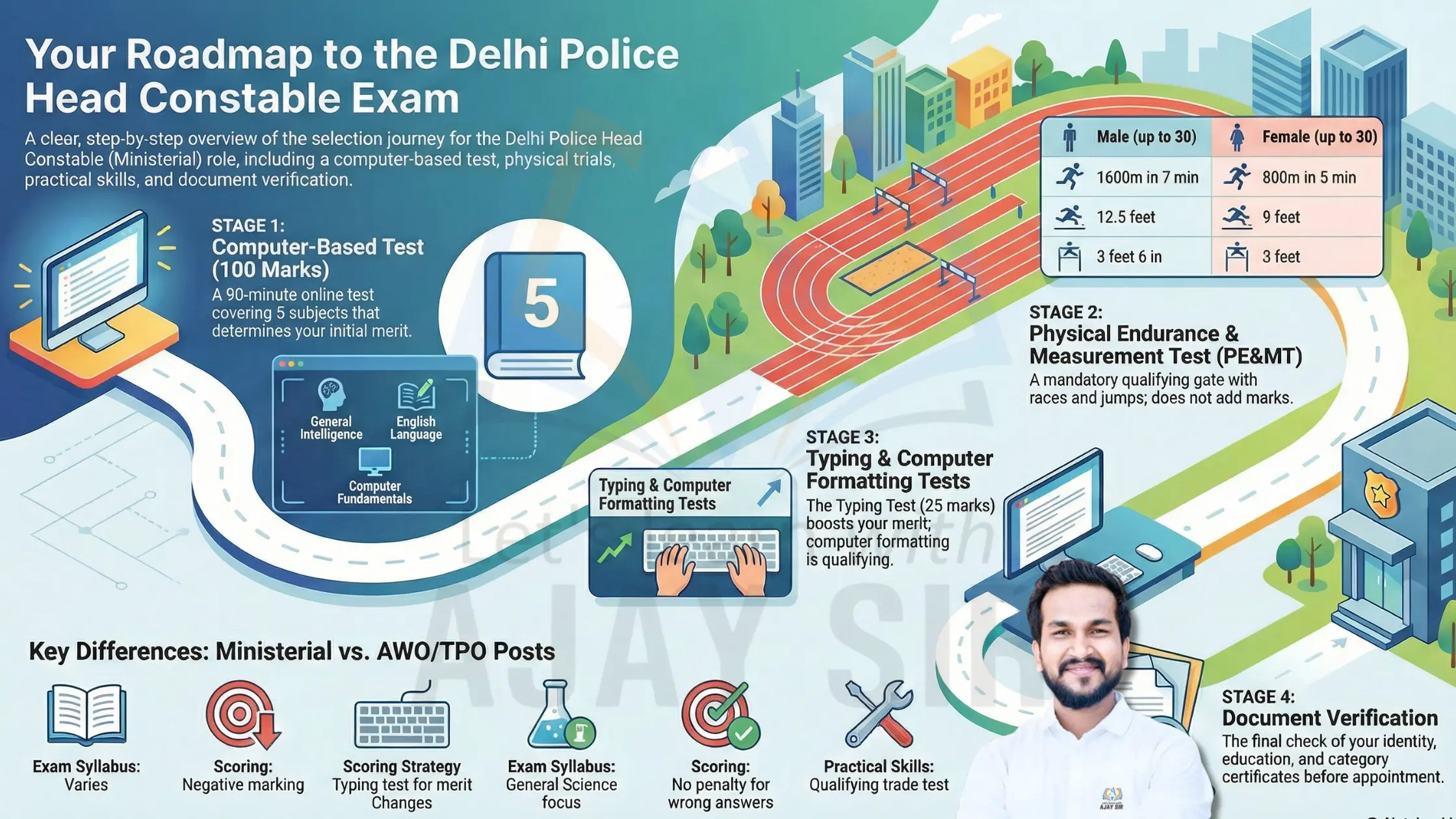
A typical CBT for this role contains 100 questions to be solved in just 90 minutes — that means an average of less than a minute per question.
This introduction gives you a clear, practical view of the pathway so you can plan your preparation with confidence.
You will see the five-section test design used recently: general awareness, quantitative aptitude, general intelligence, English, and computer fundamentals.
Know the stages: the CBT leads to physical tests, typing, and a computer formatting check before document verification.
Timing, marks, and negative-mark rules vary across sources, so adopt a flexible approach until official confirmation.
Actionable benefit: by the end of this article, you will have a step-by-step checklist covering topics, section weightage, fitness benchmarks, and typing targets to shape your weekly plan.
Quick Overview
1. Delhi Police Head Constable Ministerial Syllabus: Introduction
Begin by plotting a timeline that ties every study task to a measurable outcome, from CBT to document verification. Use the 2025 Delhi police structure (100 questions in 90 minutes, PE&MT, typing, and computer formatting) as your baseline. This gives you a realistic scaffold for 2026 updates.
Monthly milestones keep progress clear. Break the plan into syllabus coverage, mock cycles, typing drill, and fitness blocks. Prioritise sections that yield quick marks — basic aptitude, reasoning,g, and general awareness — before tackling harder topics.
Weekly rhythm matters: mix concept study, timed test practice, and revision. Mirror the 90-minute test in at least one full-length mock each week. Allocate daily windows for English/Hindi typing to hit the 25–30 wpm target and include computer formatting practice.
Schedule PE&MT in phased blocks for endurance and technique.
Prepare a compact document checklist before DV.
Track accuracy, attempt rate, and negative-mark strategy as rules firm up.
Finally, distinguish Ministerial from AWO/TPO routes so your mock papers match your chosen head constable post. Stay flexible and adjust stages if the official notification changes.
2. Delhi Police Head Constable Ministerial Syllabus: Exam pattern, stages, and marking scheme
Knowing the test sequence helps you focus your effort on the scored stages and clear the qualifying hurdles.
2.1 Computer-Based Test: sections, questions, and time
The CBT follows the 2025 model: five sections, 100 MCQs, and 90 minutes in total. Sections are General Awareness (20), Quantitative Aptitude (20), General Intelligence (25), English (25), and Computer Fundamentals (10).
Each MCQ carries one mark. Use section-wise timing—short blocks for GA and fundamentals; longer runs for reasoning and English.
2.2 Negative marking, scoring, and language
Sources list two negative-mark values: -0.25 or -0.50 per wrong answer. Verify the notified value when the official update appears and adjust your guessing strategy accordingly.
The CBT is usually bilingual (English and Hindi), so practice questions in both languages to build speed and confidence.
2.3 Physical Endurance and Measurement Test (qualifying)
PE&MT is a gate you must clear; it does not add to marks. Treat fitness work as mandatory training alongside academics to avoid disqualification at the qualifying stage.
2.4 Typing and Computer Formatting tests
The Typing Test is a 25-mark component and counts towards merit. Target accuracy and speed—roughly 30 wpm in English or 25 wpm in Hindi—to secure full marks.
The Computer Formatting Test is qualifying. It checks MS Word, PowerPoint, and Excel skills; focus on formatting, basic formulas, and slide layout.
2.5 Document verification and final merit
Document Verification is the final administrative stage. Keep identity, education, and category certificates ready and consistent to avoid delays that can cost you an appointment.
Stage | Nature | Marks | Impact |
CBT | 100 MCQs; 5 sections; bilingual | 100 (1 mark each) | Determines the major portion of merit |
PE&MT | Physical tests; qualifying only | Qualifying | Mandatory gate to proceed |
Typing & Formatting | Typing (speed/accuracy); Formatting (MS Office) | Typing: 25; Formatting: Qualifying | Typing adds to merit; formatting must be cleared |
Document Verification | Identity, education, category proofs | Qualifying | Final verification before appointment |
3. Delhi Police Head Constable Syllabus 2026: section-wise coverage
Break the syllabus into focused modules so you can target quick wins in every section. Use the 2025 outline as your baseline and adjust only if the official notification changes.
3.1 General Awareness
What to cover: History, culture, geography, economy, polity, science, and current affairs. Focus on 6–8 months of current events and static topics that yield quick marks.
3.2 English Language
Focus on comprehension, cloze tests, error spotting, sentence improvement, and vocabulary. Keep a small rules diary for grammar and common idioms.
3.3 General Intelligence
Practice analogy, series, coding–decoding, and visual reasoning. Timed drills improve speed and reduce careless mistakes.
3.4 Quantitative Aptitude
Cover percentages, ratios, time & work, mensuration, and basic algebra/geometry. Maintain a formula sheet for last-minute revision.
3.5 Computer Fundamentals
Learn MS Word, Excel functions, email operations, and safe internet use. Emphasise practical word processing and formatting tasks.
4. Delhi Police Head Constable Ministerial Syllabus: AWO/TPO variant
Choosing the AWO/TPO variant changes which sections you must master and how you attempt the paper. The CBT keeps 100 MCQs and 90 minutes, but replaces English with general science and adjusts the marks.
4.1 Pattern: section split and timing
Format: General Awareness 20, General Science 25, Mathematics 25, Reasoning 20, Computer Fundamentals 10. Total 100 questions in 90 minutes with no negative marking.
4.2 Key syllabus focuses
Target basic Physics and Chemistry concepts (laws of motion, electricity, and everyday chemistry). For maths, prioritise algebra, geometry, trigonometry, and data interpretation.
Reasoning models include series, coding-decoding, and puzzles. Keep computer fundamentals practical: MS Office basics and email operations.
4.3 No negative marking: impact on strategy
With no penalty, you can attempt broadly. Start with high-certainty questions, then use educated guesses on remaining items to maximise marks.
Factor in the qualifying Trade Test (reading and dictation) and a Computer Proficiency Test; both are mandatory.
Avoid redundant English study if you focus only on AWO/TPO; still, revise GA topics that overlap both variants.
Use full-length mocks simulating the no-penalty environment to refine pacing and attempt strategy.
Aspect | AWO/TPO | Ministerial | Action for candidates |
CBT sections | GA 20, Gen Science 25, Maths 25, Reasoning 20, Computer 10 | GA 20, Maths 20, Reasoning 25, English 25, Computer 10 | Choose mock papers matching your applied variant |
Negative marking | None | Present (varies) | Attempt more questions in AWO/TPO; be conservative in Ministerial |
Non-CBT stages | PE&MT (qualifying), Trade Test, Computer Proficiency | PE&MT, Typing (merit), Computer Formatting | Train for both physical and practical tests early |
5. Delhi Police Head Constable Ministerial Syllabus: Physical standards, endurance tests, and measurements
Your fitness profile matters: meeting the physical benchmarks is as crucial as acing the written exam. You must clear the qualifying PET and PST marks to move ahead.
Male and female race and jump targets:
Male: up to 30 yrs — 1600m in 7 min; long jump 12½ ft; high jump 3'6". 30–40 yrs — 8 min; 11½ ft; 3'3". Above 40 — 9 min; 10½ ft; 3'0".
Female: up to 30 yrs — 800m in 5 min; long jump 9 ft; high jump 3'0". 30–40 yrs — 6 min; 8 ft; 2'6". Above 40 — 7 min; 7 ft; 2'3".
5.1 PST measurements and medical checks
Category | Height | Chest (males) |
Male | 165 cm | 78–82 cm |
Female | 157 cm | N/A |
Medical essentials: you need good physical and mental health and vision of 6/12 in both eyes (with or without glasses). There is no relaxation in medical standards, so get an early check-up.
5.2 How to prepare safely and effectively
Train with a progressive plan that builds speed and stamina. Use interval runs, mobility work, and joint-friendly conditioning to avoid injuries.
Integrate plyometrics and technique drills for jumps. Mirror the PET order in practice so you manage energy and time on the test day.
Verify PST standards early and gather any required category documents.
Log baseline runs/jumps every fortnight and adjust loads.
Prioritise recovery: sleep, stretching, and nutrition matter as much as workouts.
Do a basic medical and vision check to prevent last-minute surprises.
6. Delhi Police Head Constable Ministerial Syllabus: Typing, computer formatting, and practical skills
Turn routine office tasks into test-ready skills. You will set clear typing targets and pair them with short, timed drills. The Typing Test carries 25 marks for ministerial roles, so speed with accuracy matters.
Typing targets: aim for 30 wpm in English or 25 wpm in Hindi. Do daily touch-typing sessions, practise official-style passages, and track errors to build consistency.
6.1 Word processing and formatting
Master headings and styles, tables, bullets, alignment, and page setup. Learn to follow instructions precisely; neat output wins qualifying checks.
6.2 MS Excel Essentials
Focus on cell entry, editing, basic formulas, and key functions: SUM, AVERAGE, COUNT, MIN, and MAX. Apply simple formatting to improve clarity.
6.3 Professional email and internet basics
Use clear subject lines, concise bodies, and proper attachments. Practice secure logins, trusted sites, and basic search operators for quick web research.
Task | Target | Practice drill | Why it matters |
Typing (English/Hindi) | 30 wpm / 25 wpm | Daily 15–20 min timed passages | Counts 25 marks; improves merit |
Word formatting | Headings, tables, bullets | Format sample notice in 10 min | Qualifying shows instruction-following |
Excel basics | SUM, AVERAGE, COUNT, MIN, MAX | Prepare 5 simple sheets weekly | Used in formatting test; speeds task completion |
Email & web | Professional layout; safe browsing | Compose sample mail; verify sites | Everyday office skill; avoids test errors |
Conclusion
Close your preparation loop by syncing mock tests, endurance drills, and document checks on a single calendar. Use the 2025 ministerial structure as your working guide until the official update appears, and adapt strategy fast when rules change.
What you gain: a compact checklist for CBT focus, PET/PST readiness, typing and formatting practice, plus tidy document packs for DV. Prioritise high-yield topics in general awareness, reasoning, aptitude, and computer fundamentals to lift marks efficiently.
Keep a steady mock rhythm and track analytics to tune speed, accuracy, and attempt order. Stay consistent: progressive endurance training and daily typing will make the physical endurance and typing test routine rather than a hurdle for candidates.
Confirm negative marking and final stage rules early, then stick to your plan and measure weekly progress.