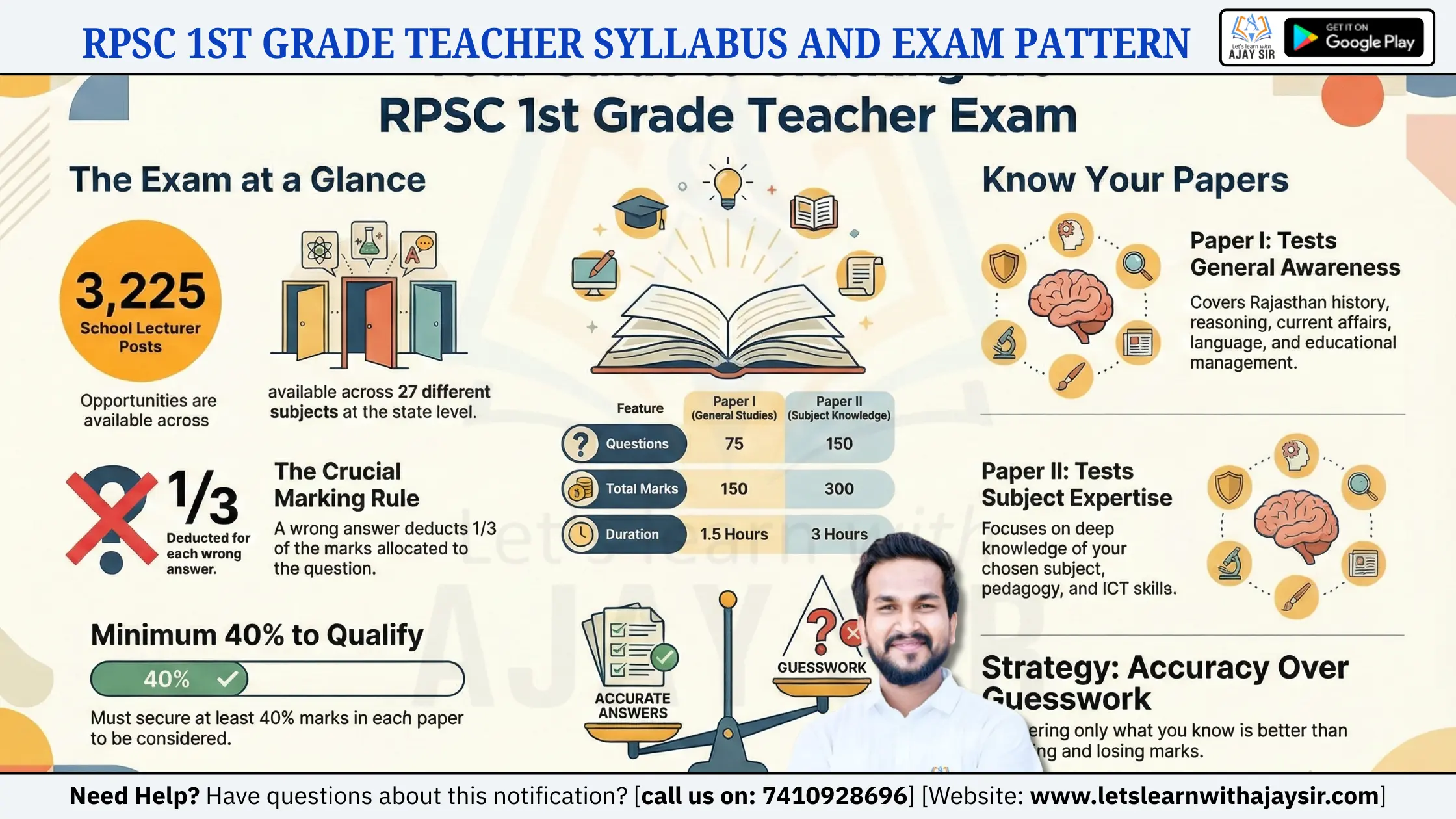
You will get a clear view of the two-paper structure used for selection. Paper I tests general awareness; Paper II checks subject knowledge. Each paper has set timings, question counts, and a strict marking rule that deducts one-third for a wrong answer.
This introduction shows what matters: how many questions appear, how marks are awarded, and why a focused plan beats guesswork. You will learn the minimum qualifying score per paper and why accuracy is vital.
Official subject-wise PDFs are available for download so you can align your study with the exact topics for Hindi, English, Science, Maths, Social Sciences, and special posts such as Coach or Physical Education.
In short: read on to map your study plan to the exam pattern, track timing and negative marking, and grab the right pdf resources to prepare with confidence.
Quick Overview
Get a quick snapshot of vacancies, paper structure, and the mandatory pass criteria you must meet. The Rajasthan Public Service Commission is running a state-level recruitment for 3,225 school lecturer posts across 27 subjects.
Selection uses two written stages, followed by document verification. Paper I covers General Awareness and General Studies. Paper II tests subject knowledge at senior secondary, graduation, and post‑graduation levels.
Both papers apply a one‑third negative marking rule for wrong answers. Candidates must secure a minimum of 40% in each paper to progress. This marking scheme shapes how you attempt questions and plan practice sessions.
A wide subject range gives many opportunities, but also stiff competition.
Focus Paper I on history, geography, polity, and current affairs.
Use Paper II to deepen core domain knowledge for your chosen subject.
Item | Detail | Why it matters |
Vacancies | 3,225 posts across 27 subjects | Shows scale and subject-wise opportunity |
Selection stages | Two written papers + document check | Clarifies what to prioritise now |
Marking scheme | -1/3 for wrong answers; 40% per paper to qualify | Influences attempt strategy and accuracy |
Syllabus focus | Paper I: general studies; Paper II: subject depth | Guides study plan and resource choice |
Syllabus & Exam Pattern
RPSC 1st Grade Teacher Exam Pattern 2025 and marking scheme explained
Understand exactly how the written stages are structured, timed, and scored to plan attempts. This clarity helps you manage time, guard marks, and choose when to guess.
Paper I structure: questions, marks, and duration
Paper I is a 75‑question objective test worth 150 marks and lasts 1.5 hours. That gives you about 72 seconds per question.
Paper II structure: subject knowledge across levels
Paper II has 150 questions for 300 marks in 3 hours. It tests deeper subject knowledge, so balance speed with careful reading.
Negative marking and minimum qualifying marks
Both papers award 2 marks for each correct answer and deduct one‑third of the marks for a wrong answer. Leaving a question blank carries no penalty. You must score at least 40% in each paper to qualify.
Special patterns for Coach and Physical Education
The Coach pattern mirrors the standard layout with identical marks, times and negative marking. Physical Education differs: Paper I has 100 questions for 200 marks in 2 hours, while Paper II has 130 questions for 260 marks in 2 hours.
How scores are calculated and what not to guess
To estimate the net score, multiply the correct answers by 2, then subtract 0.666 for each incorrect one. Practice this to decide when to skip rather than guess.
Attempt strategy: answer sure‑shot items first, then return to tougher question choices.
Simulate timing: tailor practice sets to each pattern so your stamina matches the real test.
RPSC 1st Grade Teacher Syllabus: Paper I detailed syllabus
Knowing the exact Paper I topics helps you spend time where marks are most likely. This paper tests broad knowledge across state and national themes. Focus on clear, repeatable topics so revision stays efficient.
History connections and regional context
Study Rajasthan’s dynasties, key cultural sites, and major historical events. Link these to the Indian national movement to build a quick recall.
Reasoning, maths, and basic statistics
Work on series, analogies, data interpretation, and simple probability. Practice secondary‑level maths and statistics to lift your numeracy score.
Language ability
Sharpen Hindi and English basics: vocabulary, grammar, and short comprehension. These items give quick marks when you focus on accuracy.
General awareness and governance
Track current affairs for India and Rajasthan, recent schemes, awards, and state news. Cover general science basics and the Indian polity: Constitution, Parliament, and governance structures.
Geography and education topics
Map Rajasthan’s physiography, resources, industries, and climate. Also, revise educational management, the state education scene, and the Right of Children to Free and Compulsory Education Act, 2009.
Study checklist
Create a topic‑wise checklist for daily revision.
Allocate short-term practice for reasoning and language each day.
Use current affairs notes for weekly updates focused on India and the state.
Topic | Focus | Study tip | Mock weight |
History (Rajasthan) | Dynasties, heritage sites | Use timelines and maps | High |
Mental ability & Maths | Series, DI, probability | Daily short quizzes | Medium |
Language (Hindi/English) | Grammar, comprehension | Timed passages | High |
Polity, Science, Geography | Constitution, basics, physiography | Flashcards and current notes | High |
RPSC 1st Grade Teacher Syllabus: Paper II detailed syllabus
Paper II demands deep subject mastery across school and university levels, plus pedagogy and ICT skills. You will prepare material that spans senior secondary, graduation, and post‑graduation level topics, tailored to the knowledge subject concerned.
Core domains: each of the 27 subjects has a focused list. For example, mathematics covers algebra, calculus, coordinate geometry, and statistics. English includes literature, linguistics, and language pedagogy. Science subjects test theory, experiments, and applications.
Educational Psychology and pedagogy appear as objective items. Learn learner characteristics, memory, motivation, questioning techniques, and Bloom’s taxonomy to answer teaching‑oriented questions with confidence.
Teaching Learning Material (TLM) and ICT form a practical section. You must show low‑cost TLM ideas, digital asset use, basic computer information technology skills, and formative assessment tools.
Review past trends to spot high‑weight sub‑domains.
Mix easy, medium, and hard question sets to build speed and depth.
Plan revision by level so topics at senior secondary to post‑graduate depth are covered.
RPSC 1st Grade Teacher Syllabus and Exam Pattern 2026
Understand the selection framework so you can shape study time and practise under realistic conditions.
Scope of the two-paper selection process
You face two objective papers that test different skills. Paper I covers broad awareness and general studies. Paper II checks subject knowledge at deeper levels.
Key points to note:
There are 3,225 posts across 27 subjects, so pick a subject strategy early.
Objective questions dominate; practice MCQs to build speed and accuracy.
Both papers use one‑third negative marking, and you must score at least 40% in each to qualify.
RPSC School Lecturer recruitment context and subjects
After the written stage, document verification follows for shortlisted candidates. Match your mock tests to the exam pattern 2025 so timing and question load mirror real conditions.
Item | Detail | Why it matters |
Posts | 3,225 across 27 subjects | Shows scale and subject choice |
Scheme | Two objective papers + verification | Affects the preparation plan |
Attempts | Practice MCQs, avoid wild guesses | Protects marks under negative marking |
RPSC 1st Grade Teacher Syllabus: Preparation Strategy
Analysing past question sets uncovers weightage trends and common trap items. Start by solving several previous year papers to see which topics repeat, the usual difficulty band, and how questions are framed.
Using previous year papers to understand the weightage and difficulty
Work through at least five previous year papers with an answer key. Mark topic tags for each question so you can build a heatmap of high-yield areas.
Focus: note repeated concepts, typical distractors, and time taken per question.
Weekly plan for Paper I vs. Paper II coverage
Create a weekly split: fix two days for Paper I revision (current affairs, static topics) and use the remaining days for Paper II depth practice.
Run one full mock per week that mirrors real durations to train pacing and stamina.
Accuracy over guessing: mastering the ⅓ negative marking
Adopt a strict rule: answer only when you can eliminate at least one option. Skipping protects marks better than random guesses.
Keep an error log for conceptual slips and careless mistakes.
Plan revision loops for high-yield topics and tough chapters.
Mix subject-level sets to sharpen transitions between theory, application, and pedagogy items.
Action | Why it helps | Target |
Solve previous year papers | Find weightage and traps | 5+ papers |
Timed mock practice | Improve pacing and focus | Weekly |
Error log & revision loops | Reduce repeat mistakes | Daily review |
Final tip: track mock marks to ensure you clear the 40% threshold in both papers with a safety margin. In the last week, revise summaries, formula sheets, and quick polity and geography notes for sharp recall.
Conclusion
Keep your plan simple: split daily slots for Paper I breadth and Paper II depth. Use official pdf downloads to match topics to practice sets.
Remember the marking scheme: 2 marks per correct answer and one‑third deduction for wrong ones. That rule makes accuracy more valuable than random guessing.
Track marks from weekly mocks, fix weak topics, and add short revision loops for current affairs, pedagogy, and computer information technology. This helps you face the service commission’s selection with confidence.
With the full grade teacher syllabus, clear pattern details, and steady practice, you are ready to approach the recruitment this year with calm and purpose.