This guide gives you a friendly walkthrough of the recruitment process and the exact exam pattern you will face. You will see how marks differ for tgt and pgt, how no negative marking changes tactics, and which sections demand priority.
Quick wins: focus on General Knowledge, English, Quantitative Aptitude and your Concerned Subject first. We also explain how to get the subject-wise pdf and where to download official notices at upsessb.org.
Keep this introduction as your map: it sets out what is new, how many questions appear, the marks per correct answer for each post, and the key dates so you can plan mock tests and weekly targets with confidence.
Syllabus & Exam Pattern
Know the precise question count, timing, and scoring here so your mock tests match the official format.
TGT pattern at a glance
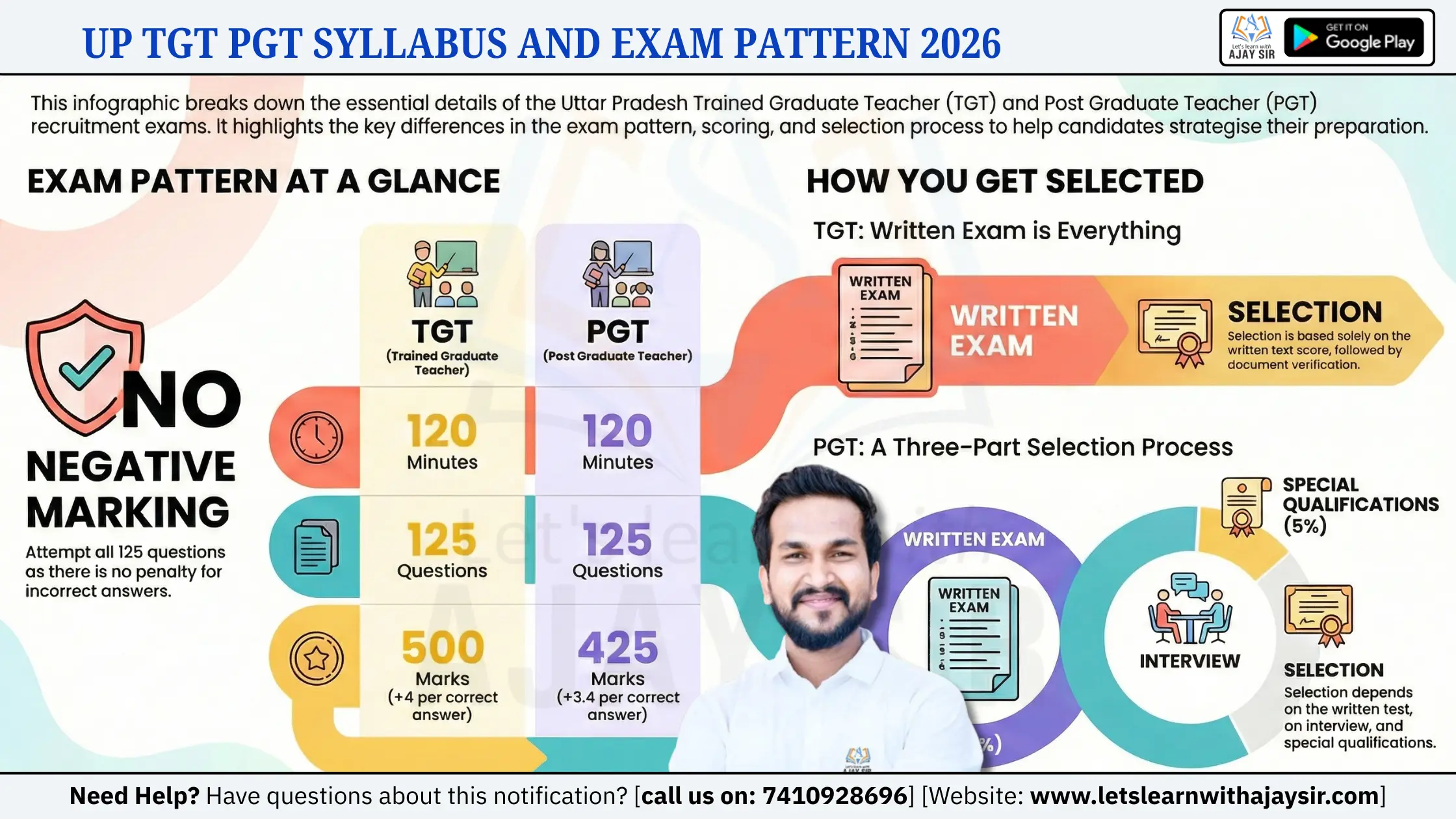
The TGT paper contains 125 questions to be answered in 120 minutes. Each correct response awards +4 marks, giving a total of 500 marks.
PGT pattern at a glance
The PGT test also has 125 questions and the same 120-minute window. Each correct answer scores +3.4 marks, so the paper totals 425 marks.
No negative marking: attempt strategy
There is no negative marking, so avoid leaving items blank. Use educated guesses after eliminating one or two choices.
Prioritise high-confidence questions first, then mark uncertain items for a quick revisit in the final 20–30 minutes.
Offline, objective mode: what to expect on the day
The exam is offline and objective-type (MCQ). Practice filling the bubble sheet quickly and clearly to avoid scanning errors.
Split your time: aim 50–60 minutes for core subject + 50–60 minutes for common sections, keep 10–20 minutes for review.
Scan the paper first: answer easy items to build momentum and bank marks early.
Carry printed admit card, original ID, and two pencils/eraser for neat shading.
Feature | Quantity | Notes |
Total questions | 125 | Same for both posts |
Duration | 120 minutes | Plan paced sections |
Marks | 500 / 425 | TGT: 500 marks; PGT: 425 marks |
UP TGT PGT Syllabus and Exam Pattern 2026: Marks weightage, interview, and documentation
Know how final scores form the merit list. Understanding marks and the selection process helps you plan study and interview time with purpose.
PGT selection combines a strong written showing with an interview and extra qualification weightage. The split is:
Component | Marks | Percent |
Written exam | 425 | 85% |
Interview | 50 | 10% |
Special qualification | 25 | 5% |
Why this matters
You must prioritise the written exam without ignoring interview practice. A strong written score gives you the bulk of the advantage, while the interview and certificates can decide close ranks.
TGT and documentation
For TGT, the process is simple: the written test carries full weight (500 marks), and selection follows document verification only. Keep your proofs ready.
Prepare ID, eligibility proofs, and category certificates early.
Track instructions for recruitment and keep original documents organised.
Start light interview prep for PGT three to four weeks before interviews.
UP TGT PGT Syllabus 2025
You will get a clear, day-by-day approach that turns the official outline into an actionable study plan.
This compact map lists every area you must cover across the common sections—General Knowledge, English Language, and Quantitative Aptitude—and your chosen subject. Use it to structure study weeks and to measure progress.
What to focus on first: start with NCERT basics and a shortlist of trusted books to build your foundation before moving to chapter-wise practice and mock tests.
Split weeks: conceptual study (4 days), chapter practice (2 days), timed review (1 day).
Layer revision: revisit difficult topics every 7–10 days and rotate strengths weekly.
Track progress: a simple tracker helps candidates spot weak clusters and log solved questions.
Translate outline to schedule: convert each syllabus topic into a 30–60 minute task with target questions.
Topic | Study focus | Suggested resource |
General sections | Concepts + weekly tests | NCERT + standard books |
Concerned subject | Core theory + past-paper practice | Subject-specific books |
Revision | Spaced cycles + mock exams | Compiled notes & PDFs |
Following this plan aligns the syllabus 2025 outline with how exam questions are normally framed and keeps your preparation practical and measurable.
General Knowledge (GK) syllabus for TGT and PGT
A focused GK routine turns scattered facts into easy-to-recall answers on exam day.
Cover these core areas: Indian history and culture, polity and the constitution, geography of India and Uttar Pradesh, economy and banking, general science and technology, plus current affairs at national, international, and state levels.
Indian history, culture, polity, and constitution
Study ancient to modern history, major movements, key dates, and cultural landmarks. Learn basic constitutional provisions, important amendments, and central institutions that frequently appear in the exam.
Geography of India and Uttar Pradesh
Focus on rivers, climate zones, soil types, crops, and national parks. Memorise district-level facts and major rivers within Uttar Pradesh for targeted questions.
Economy, banking awareness, and general science
Track budgets, major schemes, RBI basics, and financial institutions. In science, revise fundamental concepts and recent Indian missions or R&D milestones that are often tested.
Current affairs: national, international, and Uttar Pradesh-specific
Use reliable sources daily. Read a national newspaper, download monthly current-affairs PDFs, and keep a rolling one-page note for each month.
High-yield prep tips for the GK section
Use NCERTs (classes 6–12) as your backbone for history, polity, and geography.
Solve past papers and timed quizzes to build speed and recall.
Make short, dated notes for monthly revision and highlight UPS-specific facts.
Keep a small pocket file of key facts and revise them on off days.c-wise coverage
A focused chapter-by-chapter route makes the quantitative section far less intimidating.
Start with basic concepts: simplification, numbers, and percentage rules. These are the backbone for faster work on profit & loss, averages, and ratio questions.
Move to applied topics next. Practice Time, Speed & Distance (TSD), Time & Work, and Boats & Streams using stepwise templates so you solve similar questions with a fixed routine.
Data interpretation and mixed practice
Train on graphs, tables, and pie-charts to build DI speed. Begin with individual chapter drills, then do sectional quizzes, and finally mixed sets that mirror the exam pattern.
Create a personal formula sheet and a log of repeating question types.
Use approximation and mental maths to eliminate wrong choices quickly.
Follow a progression: concept drills → sectional tests → full-length mock papers.
Compact books and class 10-level notes suit this paper best. As a trained graduate candidate, you can leverage school fundamentals to score consistently by focusing on accuracy and speed.
Topic | Study focus | Difficulty |
Simplification & Numbers | Tables, LCM/HCF, decimals | Easy–Medium |
Percentages, Profit & Loss, Interest | Compound questions, shortcuts | Medium |
Time, Work, Pipes & Cisterns | Unit rates, combined work templates | Medium–Hard |
Time, Speed & Distance; Boats | Relative speed, stream impact | Medium |
Data Interpretation & Mixed Sets | Graphs, tables, speed tests | Medium–Hard |
English Language syllabus: grammar, usage, and comprehension
GK Subtopic | Study focus | Recommended resource | Why it matters |
History & Culture | Chronology, movements, monuments | NCERT + standard books | Frequent, direct questions |
Polity & Constitution | Articles, amendments, institutions | Constitution summary + notes | High-scoring conceptual items |
Geography & Environment | Rivers, climate, and protected areas | NCERT + state handbooks | Many location-based questions |
Economy, Banking & Science | Budget, policies, missions | Monthly PDFs + newspapers | Current and evolving topics |
Final tip: blend daily reading with weekly mock tests and condense each week’s learning into one page of notes. This makes last-minute revision fast and effective for candidates aiming to clear the exam with confidence.
Quantitative Aptitude syllabus: topicwise
Focus on clear, testable English skills so you convert quick study into reliable marks on exam day. The section blends grammar drills, targeted vocabulary, and short passage practice to raise your accuracy.
Grammar and usage should be systematic. Work on tenses, articles, prepositions, and subject–verb agreement with short daily exercises. Add punctuation and usage items to avoid common traps.
Vocabulary and reading skills
Build word power with a daily list of synonyms, antonyms, and idioms in context. Use small, dated notes to store tricky phrases and meanings.
For comprehension, practise scanning, locating evidence, and ruling out wrong choices to pick the best answer fast.
Error spotting and rearrangement
Create a compact checklist for agreement, parallelism, modifier placement, and tense consistency. Use it while you correct short passages to lock patterns into memory.
Alternate grammar drills with 2–3 short unseen passages per session.
Practice sentence rearrangement using connectors and pronoun references.
Review mistakes weekly so accuracy improves steadily across mocks and exams.
Area | Focus | Resource |
Grammar | Tenses, articles, prepositions, and agreement | Concise books |
Vocabulary | Synonyms, antonyms, idioms | One-page notes |
Reading | Comprehension, error correction, and rearrangement | Timed passage practice |
Follow this compact plan, and you’ll turn modest daily effort into steady score gains for both tgt and pgt style exams.
Concerned Subject focus: Hindi and Mathematics essentials
A targeted study map for Hindi and Mathematics will turn broad topics into exam-ready blocks. Use short daily tasks to build depth and speed.
Hindi: literature, linguistics, and grammar
Cover literary periods from आदिकाल to modern times and note key authors and genres. Learn short summaries of major works so you can recall facts fast in the paper.
Revise काव्यशास्त्र basics — रस, छन्द and अलंकार — and practise identifying them in short extracts. For भाषा-विज्ञान, focus on dialects, phonetics and Devanagari rules.
Keep grammar drills on लिंग, वचन, सन्धि, समास, and sentence correction. Add concise संस्कृत notes for सन्धि, समास, and common रूप to speed up translation items.
Mathematics: structured progression and depth
Start algebra and coordinate geometry with concept drills. Move to calculus, differential equations, and statistics in staged cycles.
For the pgt level, include matrices, linear transformation, and group theory. Trigonometry, vector analysis, and statics round out the practical topics.
Sequence: algebra → coordinate geometry → calculus → applied topics.
Problem split: short concept drills, medium mixed sets, timed full papers.
Tips for a trained graduate: focus on proofs and methods for pgt questions; aim for speed for TGT items.
Topic | TGT focus | PGT focus |
Hindi literature | Periods & key authors | Critical analysis & themes |
Grammar & linguistics | Rules + error spotting | Applied linguistics & translation |
Mathematics | Algebra, trigonometry, calculus basics | Linear algebra, group theory, advanced analysis |
Exam strategy: Prioritise high-yield subtopics when time is tight. Map your practice to the official syllabus tgt PDF, keep notes tidy for quick revision, and align study with the recruitment timeline in Uttar Pradesh.
Conclusion
Final note: Use the exam pattern 2025 as your timetable. Know the question count, marks, and the absence of negative marking so you can time your attempts and review smartly.
Plan your last month around timed mocks, concise notes and previous year papers. Keep subject-wise PDFs organised and download pdf copies to avoid version confusion.
Check your admit card and travel plans early. For 2025 tgt and pgt roles, focus on high-yield chapters, regular full-length tests and clear documentation for recruitment steps.
Stay calm, practise intelligent attempts and trust this roadmap: steady preparation, targeted books and disciplined mocks will increase your chances on exam day.