You’ll get a clear road map that turns a long syllabus into weekly, bite-sized study goals. This section explains the full structure and shows how general studies and your chosen subjects fit together.
What you’ll take away:
How the Prelims and Mains structure shapes your priorities and daily study plan.
Which topics to prioritize and how to map them to a weekly routine for steady gains.
Practical tactics for objective tests and descriptive papers so your prep stays balanced.
Time-allocation tips to boost correct attempts while limiting negative marking risk.
Ways to analyze past papers so your practice targets likely repeat.
Adaptation strategies if candidates are stronger in one area than another.
You’ll also learn compact revision habits, quick recall drills, and exam-day moves that keep you calm and focused. By the end, you’ll know where to find reliable resources and how to use them without wasting time.
Syllabus & Exam Pattern
UP LT Grade Teacher Prelims Exam Pattern 2026
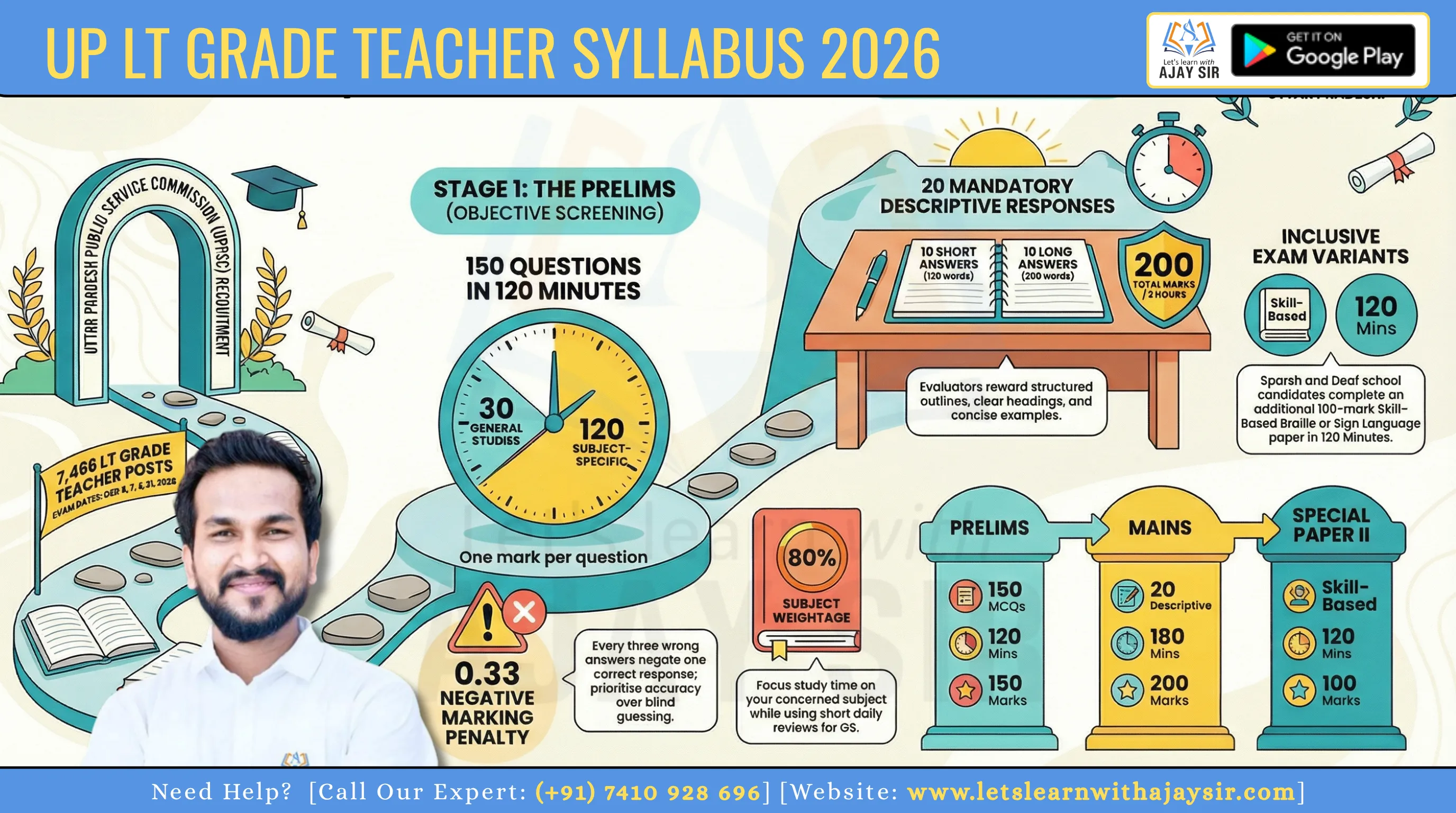
You will face a single, objective paper that totals 150 marks and tests speed and accuracy equally. This two-hour session demands a clear attempt strategy and strict time management.
Paper structure and basics:
One paper with 150 questions, each worth one mark — total 150 marks.
Duration: 120 minutes; plan your pace before you start.
Negative marking: 0.33 deducted for each wrong answer; avoid blind guessing.
Sectional breakup
Section | Questions | Marks |
Part A — general studies | 30 | 30 |
Part B — concerned subject | 120 | 120 |
Use this split to shape practice: roughly 20% of prep time for general studies and 80% for your subject. Build a timing template (for example, 25 minutes for Part A, 85 minutes for Part B, and 10 minutes for review) and refine it with timed mocks.
Key tactics:
First pass: spend under 40 seconds per question to cover all items.
Guess only when you can eliminate at least two options to protect your net score.
Practice OMR filling and track your net after subtracting marking penalties to tune your attempt strategy.
UP LT Grade Teacher Mains Exam Pattern 2026
This written stage asks you to show clarity, structure, and subject depth through timed, descriptive responses.
You will answer 20 mandatory questions split into two clear sections. Section A has 10 short answers of about 125 words each. Each short answer carries 8 marks, totaling 80 marks.
Section B contains 10 long answers at roughly 200 words each. Each long answer is worth 12 marks, adding to 120 marks. The single paper has a total of 200 marks with a duration of three hours.
Special schools and additional paper
For visually impaired and deaf candidates, Paper I remains the same (200 marks, 3 hours). A qualifying Paper II (Braille script method or Sign Language) adds 100 marks and runs for 2 hours. Prayas schools follow Paper I only.
Plan time per question and save a cushion for review and a neat presentation.
Draft a quick outline (intro, 2–3 points, brief conclusion) before writing each answer.
Use concise examples and headings to help graders award marks reliably.
Component | Count | Words per response | Marks |
Section A (short) | 10 | ~125 | 8 each (80 total) |
Section B (long) | 10 | ~200 | 12 each (120 total) |
UP LT Grade Teacher Syllabus & Exam Pattern 2026
The syllabus is divided into two clear parts: broad general knowledge and the in-depth subject you choose. This split drives how you allocate weekly hours and which topics get the largest share of practice.
Key facts at a glance:
The prelims weight favors the concerned subject (30 marks for general awareness, 120 for your subject).
Mains tests writing skill and depth across two sections totaling 200 marks, so plan timed answer practice.
Use the syllabus exam pattern to set theory blocks, timed practice, and quick reviews each week.
Build a simple study index mapping every GS and subject topic to a resource and a practice task. Keep notes modular—one page per topic—to speed final-week revision.
Part | Focus | Use |
General Studies | Breadth and current affairs | Daily short reviews, quick tests |
Concerned Subject | Depth and domain mastery | Long study blocks and mock papers |
Mains practice | Answer structure and clarity | Timed descriptive writing |
Track progress topic by topic and keep an error log so each mistake becomes next-day corrective practice. Align mocks with these milestones so you test all areas before the final phase.
UP LT Grade Teacher Syllabus 2026: General Studies Syllabus
Covering core general studies subjects lets you tackle diverse questions with confidence. Start with a simple plan: list the topic, pick one reliable source, and schedule a short revision slot every day.
Indian History and National Movement
Master social, economic, and political shifts. Build a synoptic view of the freedom struggle up to independence. Link causes, leaders, and outcomes for quick recall.
Indian and World Geography
Focus on physical features, resources, demographics, and the economic footprint that shapes development. Use maps and case examples to make concepts stick.
Polity and Governance
Study the Constitution, powers and functions, Panchayati Raj, and how public policy is made. Emphasize real-world applications and landmark judgments.
Economy, Society, Environment, and Agriculture
Understand population trends, urbanization, environmental concerns, and Indian culture. Add a primer on major crops, regional production, and market channels.
Current Affairs, Science, Math, and Language
Track weekly current events, including sports. Solidify basic science concepts and elementary math up to the 10th level. Refresh grammar and comprehension to parse questions and answer clearly.
Use weekly digests and monthly revisions.
Practice mixed question sets under time limits.
Keep short notes for rapid final-week review.
Focus | Key Elements | Study Tip | Expected Questions |
History | Social, economic, and political developments | Timelines and cause-and-effect notes | Contextual and fact-based |
Polity & Governance | Constitution, Panchayati Raj, public policy | Link theory to landmark cases | Application and definition |
Science & Math | Basic science, arithmetic, algebra, geometry | Daily drills and formula sheet | Conceptual and calculation |
Current Affairs & Agriculture | National/international events, crops, markets | Weekly notes + map references | Event-based and data-driven |
UP LT Grade Teacher Syllabus 2026: Concerned Subject Syllabus
Focus here turns a long list of topics into clear, short study slots you can use each week. Pick the subjects you will take and map core areas to daily practice. Below are compact highlights and quick tactics to boost recall and speed.
English
Key areas: parts of speech, tense, articles, prepositions, direct/indirect speech, suffixes and prefixes, collocations, phonetics, figures of speech, reading comprehension, and unseen passages.
Work short drills on grammar and phonetics every day. Practice unseen passages to sharpen comprehension.
Mathematics
Cover algebra, geometry, basic calculus, vectors, and data handling. Pair concept study with timed problem sets for accuracy under pressure.
Science
Split revision into Physics (waves, electricity, optics), Chemistry (atoms, organic basics, polymers), and Biology (cell biology, ecology, genetics). Use quick concept cards for frequent review.
Social Studies & Languages
For social studies, use timelines for history, case notes for civics, and charts for economics. In languages (Hindi, Sanskrit, Urdu), focus on grammar drills and unseen passages.
Computer: OS, DBMS, networks, C, web tech, and security basics.
Home science, commerce, physical education, arts: make flashcards for definitions and applied examples.
Subject | Focus | Study tip |
English | Grammar & comprehension | Daily short passages |
Mathematics | Problem drills | Timed sets |
Science | Core concepts | Flash cards |
Quick plan: prioritize one strong subject and rotate weaker ones into short cycles. This approach helps you cover the full syllabus without burning out before the exam.
UP LT Grade Teacher Syllabus 2026: Inclusive Variants
Candidates with special needs follow a tailored main flow that pairs the standard descriptive paper with skill-specific qualification tests. This ensures classroom skills are assessed along with subject knowledge by the Pradesh Public Service Commission.
Sparsh School (visually impaired)
Paper I: 20 questions (10 short + 10 long), 200 marks, duration 3 hours.
Paper II: Braille script/method qualification, 100 marks, duration 2 hours to validate teaching method proficiency.
Schools for the deaf and hard-of-hearing
Paper I mirrors the standard mains descriptive paper: 200 marks, 3 hours. Paper II tests sign language competency (100 marks, 2 hours), so you demonstrate the communication skills needed in class.
Prayas School (physically handicapped)
Prayas candidates take only Paper I (200 marks, 3 hours). The structure and duration match the main descriptive test used across other sections.
If you apply to Sparsh, plan weekly practice for Braille methods alongside main writing drills.
Deaf-school applicants should include sign language sessions with accredited trainers.
Confirm venue accommodations and scheduling through the service commission well before test day.
School Variant | Paper I | Paper II |
Sparsh (visually impaired) | 20 Qs, 200 marks, 3 hours | Braille, 100 marks, 2 hours |
Deaf & hard-of-hearing | 20 Qs, 200 marks, 3 hours | Sign Language, 100 marks, 2 hours |
Prayas (physically handicapped) | 20 Qs, 200 marks, 3 hours | Not applicable |
UP LT Grade Teacher Syllabus 2026: Marking Scheme, Duration, and Question Structure
Understanding the scoring system helps you choose which items to attempt and when to hold back. Read these rules so your practice mimics real test conditions and your net score improves steadily.
Prelims scoring basics
Each multiple-choice question carries 1 mark. Your net result equals correct answers minus penalties for wrong attempts. This simple math should guide every timed mock you take.
Mains evaluation approach
For the written paper, evaluators reward clear structure and relevance. Short answers and long answers together total 200 marks, so follow the suggested length and use headings to make points visible.
Time-on-task planning
Prelims run for two hours; mains give you three. Plan per‑question minutes in practice and keep a final buffer for review. Balance pace with accuracy to protect your net.
Your Prelims score equals correct answers minus the penalty for wrong responses, so accuracy must guide attempts.
The 0.33 negative marking means three wrong answers negate one correct; avoid random guessing and prefer selective attempts.
In Mains, write to the required length, stay coherent, and address the prompt directly to earn full marks.
Build a simple scoring tracker in mocks: record raw marks, subtract penalties, and study how attempt changes affect net points.
Change answers only when you have a strong reason — frequent second‑guessing costs time and can hurt your score.
Stage | Questions | Marks | Duration | Key tip |
Prelims | 150 objective | 150 total | 120 minutes | Favor accuracy over attempts |
Mains | 20 descriptive | 200 total (80 short + 120 long) | 180 minutes | Use outlines, headings, and neat presentation |
Scoring rule | N/A | Marking 0.33 per wrong | N/A | Three wrong = one lost mark |
All Details
Conclusion
Finish with a strong, focused plan that ties dates, marks, and section splits to daily tasks. You have 7,466 vacancies and clear Prelims slots on 6th, 7th, and 21st December to anchor practice.
Make time for both general studies and subject mastery. Practice mocks with the 150 questions, 150 marks, two‑hour format, and 0.33 penalty, then polish mains writing for the 200‑mark, three‑hour paper.
Include inclusive variant drills early, keep logistics ready, and track weekly gains. Use the public service commission structure to convert steady study into higher marks and a confident result for the Uttar Pradesh public drive.


![EMRS PGT [Tier-2] ENGLISH - 2025](https://letslearnwithajaysir.s3.ap-south-1.amazonaws.com/courses/FsnKxIFpiLxbRD418g6vo7AsLy0ge7IP7Iu2fsJY.webp)
![EMRS TGT [Tier-2] ENGLISH - 2025](https://letslearnwithajaysir.s3.ap-south-1.amazonaws.com/courses/BjLXVqVV1SeZKnhYjmPZpz2jQ7r02kS73pGGOLrL.webp)
![KVS/NVS PGT ENGLISH [Tier-2] - 2025](https://letslearnwithajaysir.s3.ap-south-1.amazonaws.com/courses/vqli598KWrKnm4txcsZh5qjMN9UMAX8LvFk9IiF0.webp)
![KVS/NVS TGT ENGLISH [Tier-2] - 2025](https://letslearnwithajaysir.s3.ap-south-1.amazonaws.com/courses/pxC2WhfYKuyaoGqvcTvhTBL2Y44o3TNA0z8NYRB5.webp)