Prepare with clarity. This guide gives you a clear, future-ready overview of the lic assistant syllabus and exam pattern so you can plan your study journey with confidence.
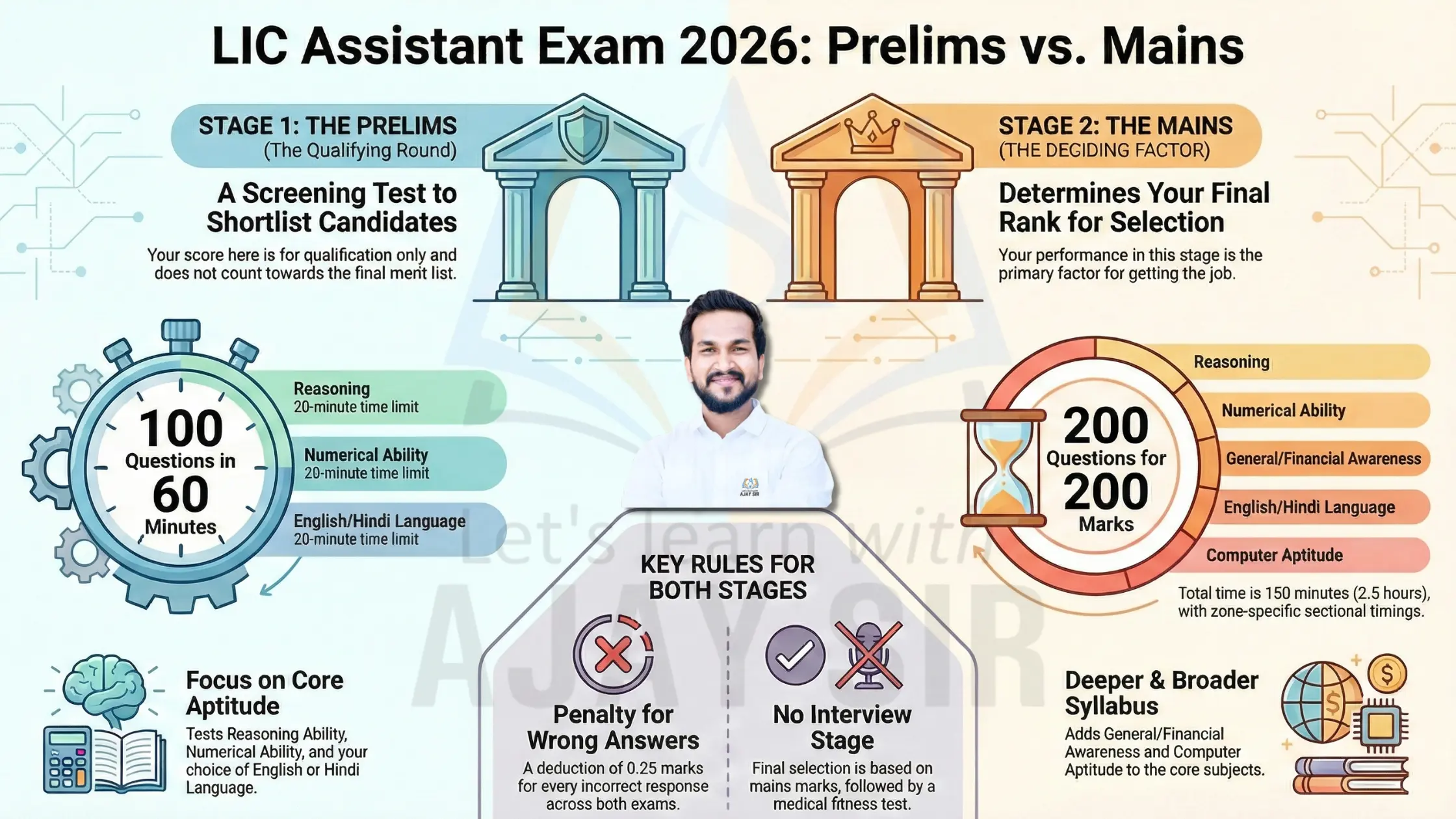
The selection has two online stages: a preliminary test and a main test. There is no interview for the appointment. Prelims has three sections — Reasoning Ability, Numerical Ability, and English/Hindi Language — with 20 minutes per section, 100 questions, and 100 marks in total.
Mains differs by zone but totals 200 questions and 200 marks, with sectional timings and zone-specific languages. Objective tests are bilingual (Hindi and English), except for the language paper.
Note the penalty: a 0.25 mark deduction for each wrong answer. Final merit is decided on the main marks, followed by a medical check for recruitment.
What you’ll gain here: exact structure, timing, scoring rules, and practical pointers to shape attempts, use mocks wisely, and align your study calendar for the year ahead.
Quick Overview
Think of this page as a single, reliable map that answers the common questions every candidate asks. You will find clear notes on topics, section weight, negative marking, and how prelims affect final selection.
Most candidates worry about which books to trust, whether prelims are only qualifying, and how to schedule mocks. This guide compiles previous year trends so you can judge difficulty and focus on high-yield areas.
You get one place that explains what each stage tests and how much time to allot per section.
Practical tips show how to blend concept work with daily mock and section drills for steady gains.
Simple planning tools help you map months into weekly blocks and daily practice stacks tailored to your level.
Result: less stress, more focused practice, and steady skill growth, so you hit the real test with better speed and accuracy.
LIC Assistant Syllabus and Exam Pattern 2026: Snapshot
You face two timed online hurdles before the final appointment: a fast screening test and a deeper mains paper. This snapshot helps you map differences fast so your study plan targets the right skills.
Prelims at a glance: three sections — Reasoning Ability (35 questions), Numerical Ability (35 questions), and English/Hindi Language (30 questions). You get 20 minutes per section, 100 questions, 100 marks, and a total of 60 minutes.
Mains in brief: 200 questions for 200 marks with zone-specific sectional timings. Some zones set English only; others include both English and Hindi for the language paper.
Negative marking: 0.25 lost per wrong answer — accuracy matters as much as speed.
Interface is bilingual except for language tests; no interview — final merit comes from mains.
Expect the same syllabus themes, but tougher questions and greater weight on reasoning, quantitative, and financial awareness.
Stage | Questions | Marks |
Prelims | 100 | 100 |
Mains | 200 | 200 |
LIC Assistant Selection Process
You move through a clear three-step route. First comes a short screening test to shortlist applicants. Next is the mains, which sets the final merit list. Finally, successful candidates face a medical check before appointment.
Prelims role in selection
The prelims are a qualifying paper. It does not add to the final merit. You must clear section-wise thresholds to reach the mains.
Mains merit, local language, and medicals
The mains decides your rank. Final merit depends only on mains marks, subject to minimum sectional and overall cut-offs. You must also prove local language ability for the division where you apply. After the mains, a medical fitness test confirms your suitability for service in the life insurance corporation.
No interview: what it means for you
There is no interview stage. That makes written performance and medical fitness the central determinants in recruitment. Focus your preparation on written tests and language skills to improve your selection odds.
Progress through qualifying stages to reach the mains.
Meet cut-offs to avoid narrow misses.
Clear medicals to finalise the appointment in the insurance corporation.
Stage | Role | Outcome |
Prelims | Shortlist candidates for mains | Qualifying only |
Mains | Determine final merit | Rank for selection |
Medical | Fitness clearance | Final recruitment step |
LIC Assistant Syllabus 2026: Prelims Exam Pattern
Prelims compress three focused tests into a single, high‑pressure hour. You must manage pace and accuracy across every part to clear section cut-offs.
Reasoning Ability — quick logic in a tight time
The reasoning section has 35 questions and 20 minutes. Focus on familiar puzzles, seating, and series to score fast.
Numerical Ability — speed with basic verification
Numerical ability also contains 35 questions for 20 minutes. Use fast arithmetic and DI snapshots, then verify critical calculations to avoid losses from the 0.25 penalty.
English/Hindi Language — choose what suits you
The language paper has 30 questions in 20 minutes. Pick the language that helps your comprehension and minimises careless mistakes.
Total duration and scoring approach
The prelims total 100 questions for 100 marks in 60 minutes. Each wrong answer deducts 0.25 marks, so avoid risky guessing.
You face three locked sections, each with a 20‑minute timer — plan an order you can repeat reliably.
Track expected marks per section while practising, so you know how many safe attempts you need.
Use the bilingual interface for reasoning and numerical prompts if it helps you work faster.
Section | Questions | Time (minutes) |
Reasoning Ability | 35 | 20 |
Numerical Ability | 35 | 20 |
English / Hindi Language | 30 | 20 |
LIC Assistant Syllabus 2026: Prelims syllabus
This quick reference maps the topics you must prioritise for fast gains in prelims. Use it to plan short, focused practice blocks that build reliable accuracy.
Reasoning focus
Core areas: analogy, classification, syllogism, coding‑decoding, blood relations, direction sense, seating arrangement, series tests, input/output, decision making.
Numerical aptitude
High-yield topics: percentages, ratios & proportions, averages, mixture & allegation, time & work, speed‑distance‑time, partnership, SI/CI, mensuration, equations, probability, permutation & combination, data interpretation.
Language skills
Practice: grammar, spotting errors, sentence correction, vocabulary (synonyms/antonyms), reading comprehension, fill‑in‑the‑blanks, and cloze tests. Daily reading deepens your usage and comprehension skills.
Prioritise puzzles, seating, and series in reasoning — they recur often and reward pattern recognition.
Make DI a daily drill to sharpen quick computation for numeric sets.
Keep short rule notes for formulas and grammar to revise the day before the test.
Section | Key topics | Why focus here |
Reasoning | Puzzles, Seating, Syllogism, Coding | Frequent, fast-to-attempt questions |
Numerical | Percentages, Ratio, DI, SI/CI | Forms the basis for many composite items |
Language | Grammar, Vocab, RC, Cloze | Improves accuracy with minimal time loss |
LIC Assistant Syllabus 2026: Mains exam pattern
In the mains, you face a multi-section paper where timing and order are as vital as knowledge. The mains totals 200 questions for 200 marks, with fixed sectional timings that vary by zone. Know the split so you can plan pace and practice.
East, South, and South Central set five papers: Reasoning & Computer Aptitude (40 Q, 30 min), General/Financial Awareness (40 Q, 30 min), Quantitative Aptitude (40 Q, 40 min), English (40 Q, 30 min), and Hindi (40 Q, 30 min). Total time is 150 minutes.
Other zones (North, West, Central, East Central, North Central) use a different order: Awareness (40 Q, 30 min), English (40 Q, 30 min), Quant (40 Q, 30 min), Reasoning & Computer (40 Q, 30 min), Hindi (40 Q, 30 min). The total time is 150 minutes too.
The main exam is a multi-section test, so refine your sequencing and section-level strategies.
Negative marking is 0.25 per wrong answer; restraint boosts net marks more than blind guessing.
Non-language sections are bilingual; choose the medium that helps you read fastest.
Zone group | Sections | Total time |
East / South / South Central | Reasoning & Computer, Awareness, Quant, English, Hindi (40 Q each) | 150 minutes |
North / West / Central / East Central / North Central | Awareness, English, Quant, Reasoning & Computer, Hindi (40 Q each) | 150 minutes |
LIC Assistant Syllabus 2026: Zone-wise mains pattern
Zone-specific timing and language choices change how you must prepare for the mains. Know which language sections apply to your region so you can target practice and avoid wasted effort.
East, South, South Central zones
The three zones set five sections of 40 questions each. Total time is 150 minutes. Both English and Hindi papers appear, but the English language focus is emphasised in the schedule.
North, West, Central, East Central, North Central
These zones test English and Hindi as separate language sections. You still face five sections of 40 questions each, but the total time expands to 2 hours and 30 minutes. Pace and stamina matter more here.
Practical tips:
Your main language mix depends on your LIC zone; set prep time for the language(s) you will face.
All zones keep 40 questions per section—build rhythm and precision in 40-question blocks.
Use mocks that mirror your exact zone stage order and timing so your practice matches the real examination.
Zone group | Total time | Sections |
East / South / South Central | 150 minutes | 5 × 40 questions |
North / West / Central / East Central / North Central | 150 minutes (2 hrs 30 mins) | 5 × 40 questions |
LIC Assistant Syllabus 2026: Mains syllabus
The main stage demands deeper practice and sharper time management across every major topic. You must move beyond surface-level tricks and build clean methods that save time under pressure.
Reasoning & computer aptitude
Advanced puzzles include multi-table seating, complex input/output, data sufficiency, and layered coding‑decoding. Expect short computer knowledge questions on common terms and basic functions. Quick recall here converts to easy marks.
Quantitative aptitude
Data interpretation dominates: tables, line/bar, and pie charts with mixed arithmetic. Core arithmetic — percentages, ratios, SI/CI, time & work — appears alongside algebra, probability, P&C, and mensuration. Learn when to skip high-effort sets to protect your marks.
General/financial awareness
Focus daily on banking terms, roles of RBI/SEBI/IRDA, monetary policy, major government schemes, and key international bodies. Keep a rolling six‑month window of current events; concise notes beat bulky compilations near the test.
English / Hindi language
Language sections test comprehension, grammar, vocabulary, paragraph ordering, and cloze tests. For Hindi, practise व्याकरण, गद्यांश and शब्दावली. Short, steady reading and daily vocab drills improve accuracy faster than last‑minute cramming.
Tip: Treat topics as ability blocks—identify high-yield areas and focus weekly practice around measurable gains.
Combine DI practice with algebra drills to handle hybrid questions.
Reserve 20–25 minutes daily for awareness and current affairs revision.
Section | Key topics | Why it matters |
Reasoning & Computer | Puzzles, data sufficiency, and basic computer skills | High accuracy, quick wins |
Quantitative | DI, arithmetic, algebra | Major marks source; time sink if unchecked |
Awareness | Banking, policy, current affairs | Needs regular short revision |
Language | RC, grammar, vocab | Consistency yields steady marks |
LIC Assistant Syllabus 2026: Marking scheme, exam language
Clear rules about penalties, language choice, and timed blocks shape how you must attempt the test. Use this section to build a safe, efficient plan that protects your net score and reduces anxiety on the day.
Negative marking
Every incorrect response attracts a 0.25 penalty. Unattempted items carry no deduction, so skipping doubtful questions often preserves marks better than guessing. Treat this rule as the backbone of your attempt strategy.
Bilingual format and switching
The objective sections are bilingual for most tests, so you can switch between Hindi and English where available. Use the medium that speeds comprehension and calculation. Language papers must be answered in their specific medium, so prepare in the exact language you will face.
Sectional timing strategy
Prelims lock each section for 20 minutes; you cannot borrow time. Practise finishing within each block to reduce last-minute rushes.
Mains give 30–40 minutes per section, depending on the zone. Build stamina with full-length mocks and set minute-by-minute anchors to hit checkpoints.
Balance ambition with restraint: aim for safe attempts first, then return to tougher items.
Audit every mock to find time leaks and poor selections; refine your blueprint after each session.
Place stronger sections early when possible to stabilise your score and calm nerves.
Feature | Prelims | Mains |
Negative marking | -0.25 per wrong | -0.25 per wrong |
Language format | Bilingual for objective sections; language paper fixed | Bilingual for objective sections; language paper fixed |
Section time | 20 minutes per section (locked) | 30–40 minutes per section (zone dependent) |
Best practice | Finish within each 20-minute block | Use anchors and stamina drills for longer sections |
LIC Assistant Syllabus 2026: previous year papers
Reviewing past question sets reveals the test’s recurring structures and time traps. Use this to build a targeted plan that reflects real difficulty, not guesswork.
What to focus on:
Solve several previous year papers to spot how many safe attempts you should aim for per section, given negative marking.
In quantitative sections, the emphasis on DI recurs often; build templates for chart reading and mixed arithmetic.
For reasoning, catalogue puzzle types and seating variants so your setup routine becomes fast and reliable.
Track the last six months of current affairs for awareness; many questions repeat institutions and schemes.
Tune your mock mix so that practice mirrors the actual question spread and difficulty from prior cycles.
Map your errors by category and attack weak links before the next test. Treat past papers as both learning tools and benchmarks for selection-grade performance.
Section | Frequent focus | Quick tip |
Quantitative | DI sets, mixed arithmetic | Build 3 DI templates |
Reasoning | Puzzles, seating orders | Practice set-ups for each puzzle type |
Awareness | Banking, schemes | Maintain a 6-month rolling note |
All Details
LIC Assistant Syllabus 2026: Preparation strategy
Smart preparation balances short sprints for prelims with long runs for mains readiness. Start with a clear two-stage plan that sets accuracy goals for the screening test and builds stamina for the final stage.
Study plan for stages and sections
Divide weekly hours by section. Allocate puzzles, DI sets, and grammar drills into fixed slots. Keep a small current affairs window for daily review so awareness stays fresh.
Time management and accuracy practices
Practise under exact sectional timers to hardwire pacing. Track first-look attempts versus return-to-hit attempts to learn which items to skip early.
Revision, mocks, and performance analysis
Use full-length mocks at realistic intervals and run deep post-mock analysis. Maintain an error log that separates concept gaps from speed faults.
Layer your training: concept → guided practice → timed sets → full mock → analysis → targeted re‑drills. Keep routines sustainable with sleep, short breaks, and light recovery days.
Two-stage plan: prelims sprint for clean accuracy; mains marathon for depth and awareness.
Weekly slots: fixed goals per section and measured progress.
Mock cadence: regular tests plus focused reviews to convert practice into marks.
Focus | Daily | Weekly | Monthly |
Speed & accuracy | Timed sets (30 mins) | Section mock | Full mock |
Awareness | News snapshot (10 mins) | Summary notes | Consolidation review |
Error management | Log fixes | Targeted drills | Progress audit |
LIC Assistant Syllabus 2026: Books, resources, and free mock
A compact stack of proven books and regular mock practice will sharpen your speed and accuracy. Choose a few core titles, then convert learning into timed drills so techniques become second nature.
Recommended titles by subject
Reasoning: R.S. Aggarwal, M.K. Pandey, B.S. Sijwali & Indu Sijwali. These cover puzzles, seating, and logical trains of thought.
Quantitative & DI: M. Tyra, R.S. Aggarwal, Rajesh Verma, Arun Sharma. Use these for rapid arithmetic and chart practice.
Language: Wren & Martin, S.P. Bakshi, Norman Lewis, plus daily newspaper reading for comprehension.
General/financial awareness: Arihant Banking Guides, Lucent GK, and short financial awareness notes focused on insurance and the economy.
Free mock platforms and how to use them
Use free mock tests on sites like ixamBee to mirror the real interface and sectional timing.
Simulate full-length runs, then do structured analysis: accuracy by section, time per question, and common error types.
Repeat focused mocks after targeted drills to track improvement and build exam stamina.
Staying updated: current affairs for insurance and finance
Spend short daily slots on banking news, policy moves, and major insurance updates. Keep a rolling weekly note to revise quickly before a test.
Section | Recommended book | Why it helps |
Reasoning | R.S. Aggarwal | Wide puzzle variety for speed |
Quantitative | Arun Sharma | DI templates and mixed sets |
Awareness | Arihant Banking | Targeted financial topics for candidates |
Conclusion
This guide helps you finish with a calm, zone‑aware plan that turns steady practice into real selection gains.
You now have a clear map of the lic assistant syllabus and the full exam pattern, from prelims screening to mains merit and the final medical check.
Focus your preparation on timed section drills, DI and puzzles, language accuracy, and steady financial awareness. Use previous year papers and structured mocks to match real timing and difficulty.
Remember: main marks decide final selection. Negative marking punishes random guessing; there is no interview, and non‑language sections are bilingual, while zone language rules vary. Track official notices and lock a calendar that peaks both stages.