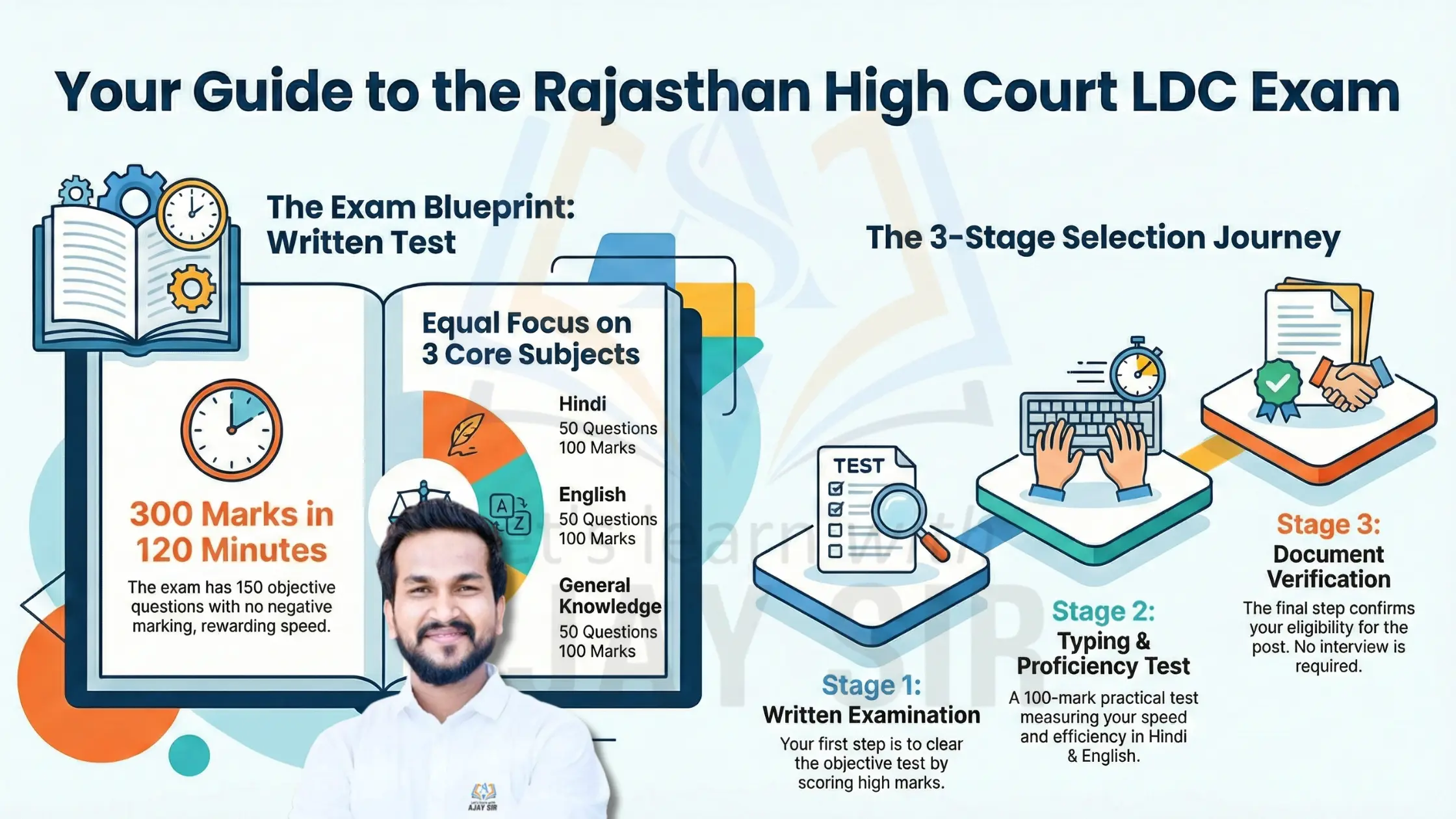
Did you know that recent written papers set 150 objective questions to be solved in just 120 minutes, with no negative marking? That pace shapes how you must plan every practise session.
This guide gives you a clear, future-ready overview of the Rajasthan High Court exam and the key topics it tests: Hindi, English, and General Knowledge. You will see how marks are split, why typing matters, and what the selection stages look like.
Prepare smart by focusing on grammar, comprehension, and regional general knowledge on history, culture, and geography. The typing or proficiency stage adds 100 marks across speed and accuracy in both Hindi and English.
Use this introduction to map your study to the actual blueprint used in recent recruitment cycles. It will help you plan timed mocks, prioritise high-return topics,, and move from understanding the syllabus to steady, daily practice.
Quick Overview
1. Rajasthan High Court LDC Syllabus: Introduction
Know what the exam will test and how the process flows so you can prepare with purpose. The written paper is an objective test across three subjects: Hindi, English, and General Knowledge.
The recent exam pattern gave 150 questions in a 120-minute duration, carrying 300 marks and no negative marking. This mix rewards speed and accuracy. Practise timed sets to build both.
After the written stage, the selection moves to a typing/proficiency test worth 100 marks, then document verification. As a candidate, treat typing practice as a daily habit.
No negative marking — attempt smartly and avoid leaving simple gains on the table.
Plan your time — 120 minutes means strict pacing by section.
Track official pdf notices to stay aligned with the latest pattern and schedule.
Component | Questions | Marks | Duration |
Written (3 subjects) | 150 | 300 | 120 minutes |
Typing / Proficiency | Practical test | 100 | As per the notification |
Document verification | — | — | Post-tests |
Stick to a steady preparation plan that maps subjects to weekly goals. Regular mocks will tune your speed for exam day and the wider selection process.
2. Rajasthan High Court LDC Syllabus 2026
Here you’ll find a concise breakdown of the topics that appear most often across the written and practical stages.
2.1 Hindi: core topics and important sub-topics
Cover grammar pillars: संधि, समास, उपसर्ग/प्रत्यय and vocabulary items such as पर्यायवाची, विलोम and अनेकार्थक. Practise वाक्य शुद्धि and वाच्य every day; short drills of two to four sentences sharpen accuracy fast.
2.2 English: grammar, usage, and comprehension focus
Prioritise tenses, active/passive and direct/indirect narration. Work on sentence correction, subject-verb agreement, degrees, and connectives. Build your word list with synonyms, antonyms, and one-word substitutions.
2.3 General Knowledge: Rajasthan, current affairs, and essentials
Focus on state history, culture, geography, and natural resources alongside daily current affairs. Group topics into weekly clusters so you can revise quickly before mixed practice sets.
Subject | Core topics | Quick tip |
Hindi | संधि, समास, वाक्य शुद्धि, मुहावरे | Daily 10‑minute drills; track common errors |
English | Tenses, voice, narration, vocab | Do 20 sentence corrections weekly |
General Knowledge | State history, geography, and current affairs | Make micro-notes on districts and projects |
Stick to the defined syllabus, focus on high-yield important topics, and practise timed sets to increase recall for the Rajasthan High Court exam.
3. Exam pattern, marking scheme, and test duration
Get a quick view of time, marks, and scoring rules to shape your mock strategy. The written paper tests three subjects: Hindi, English, and General Knowledge. It has 150 objective questions worth 300 marks and a 120‑minute duration. There is no negative marking, so you can attempt confidently while keeping accuracy first.
3.1 Written exam pattern: subjects, questions, and marks distribution
The written exam gives 50 questions per subject. Each question carries 2 marks, totalling 300 marks. Treat section-wise pacing as part of your preparation—aim for around 35–40 minutes per subject and reserve 5–10 minutes to review flagged items.
3.2 Typing and efficiency test: speed, accuracy, and scoring
The practical test is split into speed and efficiency, 50 marks each. Past patterns used short Hindi and English speed tests (often 5 minutes) plus an efficiency task (around 10 minutes). Familiarise yourself with scoring methods such as (20/8000) × net speed (depressions per hour) so you know how faster, cleaner typing raises marks.
3.3 Time and mode of test: duration, objective questions, and language
Recent exams were run in an online mode with both Hindi and English interfaces. Practise full-length online mocks to mirror navigation, timers, and language switching. Choose your preferred language at the start to save precious seconds.
3.4 Negative marking policy and normalisation
There is no negative marking, so educated guesses at a 50–70% confidence level can boost your score. If the authority applies normalisation across shifts, raw marks may be adjusted; focus on steady accuracy and time use to remain competitive.
Component | Questions | Marks | Duration |
Written (Hindi, English, GK) | 150 (50 per subject) | 300 | 120 minutes (online) |
Typing / Efficiency | Practical tasks | 100 (50 speed + 50 efficiency) | Typically 5–10 mins per task |
Normalization & policy | Shift-based adjustments | Marks may be normalised | Applied if multiple shifts are held |
4. Rajasthan High Court LDC: Selection process
The selection process follows three clear stages that you must clear to reach an appointment for the post.
First comes the written exam: 150 objective questions totalling 300 marks with no negative marking. Aim for speed and accuracy in each section to secure a high written score.
Next is the typing/proficiency test worth 100 marks. This practical stage measures speed and efficiency in both Hindi and English. Practise daily so your net speed and error rate meet the required benchmarks.
The final stage is document verification. The authority checks all educational certificates, identity proofs, and category documents to confirm eligibility.
No interview is typical in recent cycles, so focus on written marks and typing standards.
Keep documents ready: degree certificates, ID, caste or disability certificates, and application copies.
Match details on your application and papers to avoid verification delays.
Stage | What it tests | Outcome |
Written exam | Objective knowledge across subjects | Shortlisting for the practical test |
Typing/proficiency | Speed and office-ready skills | Qualify for verification |
Document verification | Eligibility and authenticity | Final selection and appointment |
Plan your preparation so that you develop both subject knowledge and practical typing skills. Track official updates from the Rajasthan High Court and stay organised—final selection depends on combined performance and successful verification.
All Details
How to prepare for the Rajasthan High Court LDC: step-by-step guide
A step-by-step plan helps you balance subject study, mock practice, and typing drills. Treat preparation as weekly progress, not last‑minute cramming. You will manage your workload better and reduce stress as a candidate.
Map the syllabus to a weekly study plan with milestones
Split your schedule into a 10–12 week plan. Allocate Hindi, English, and GK across weekdays and keep weekends for mixed mock questions. Set clear milestones every two weeks and tick them off.
Prioritise high-yield topics in Hindi, English, and GK
Start with core topics: संधि, समास, and वाक्य/शब्द शुद्धि in Hindi; tenses, voice, narration, and sentence correction in English. For GK, make micro-notes on districts, projects, minerals, and cultural facts.
Practise with objective questions, previous papers, and mock tests
Do sets of 25–50 questions to build accuracy. Scale to full mocks bi‑weekly, then weekly in the last month to mirror the written exam time and pressure. Track errors and revise them fast.
Typing practice: building speed and accuracy for the proficiency test
Begin early with 10‑minute timed drills in both scripts. Gradually increase duration and aim to reduce errors while raising net speed. Practise the actual test format so you know the scoring logic.
Time management and revision strategy for the final weeks
Create a split — about 38–40 minutes per subject with a 5‑minute buffer — and follow it strictly in mocks. In the last two weeks, focus on mixed-topic practice, redo high-frequency questions and keep one rest day to recharge before the exam.
Daily drill: 60–90 minutes topic study, 30–45 minutes MCQs, 30 minutes error‑log review.
English tip: Compile a mini book of rules and tricky sentences; include connectives and degrees of adjectives.
Hindi tip: Use flashcards for उपसर्ग/प्रत्यय and common word pairs for quick recall.
Stage | Focus | Duration |
Weekly plan | Topic study + MCQs | 10–12 weeks |
Mocks | Full-length simulated sets | Bi‑weekly → weekly |
Final weeks | Revision & mixed practice | Last 2 weeks |
Syllabus PDF, exam pattern PDFs, and trusted resources
Downloadable documents and trusted links make your prep efficient and error-free. Start by visiting the official website (hcraj.nic.in) to fetch the latest pdf notices, notifications, and downloadable forms. Save these files offline so you can check dates and criteria without connectivity issues.
Keep a dedicated folder for the main files: the syllabus pdf, the exam pattern 2025 snapshot, and any corrigenda. These documents confirm that the written test has 150 questions, 300 marks, 120 minutes, and no negative marking, and that the typing/proficiency test totals 100 marks.
Use reputable portals for free mock tests and important-questions pdf banks tailored to the clerk exam.
Pick bilingual question packs (Hindi/English) that mirror the online interface and timing.
Subscribe to alerts for vacancies and new notifications so you never miss updates.
Resource | Why save it | Where to find |
syllabus pdf | Clarifies topics to cover | hcraj.nic.in / official notices |
exam pattern 2025 pdf | Defines timing and mark split | Official downloads/notification page |
mock & current affairs PDFs | Practice and quick revision | Trusted portals/coaching sites |
Conclusion
Close the gap between study and selection by rehearsing full exam conditions. Focus on timed mocks that mirror the exam pattern: 150 questions, 300 marks, and 120 minutes with no negative marking.
Lean on daily typing drills for the 100‑mark practical and keep your documents ready for quick verification of your post‑selection credentials. There is no interview, so your written marks and typing efficiency decide selection. Stay alert for recruitment notices and vacancies, so small changes in pattern or time do not surprise you. Keep revising key topics, strengthen your English words and connectives, and refine weak areas in the final weeks.
Disclaimer:
All eligible and interested candidates are advised to read the official notification carefully before applying online.
Disclaimer: The examination results and marks published on this website are provided solely for immediate information to candidates and do not constitute a legal document. While every effort has been made to ensure the accuracy and authenticity of the information available on this website, we are not responsible for any inadvertent errors that may occur in the publication of examination results or marks. We shall not be liable for any loss or damage to any individual or entity arising from any deficiency, defect, or inaccuracy in the information provided on this website.